The Credibility Gap: Why Consumers No Longer Take Product Claims at Face Value
When every brand uses the same language, that language stops working. A closer look at what actually drives consumer belief — from specific claims to independent validation.

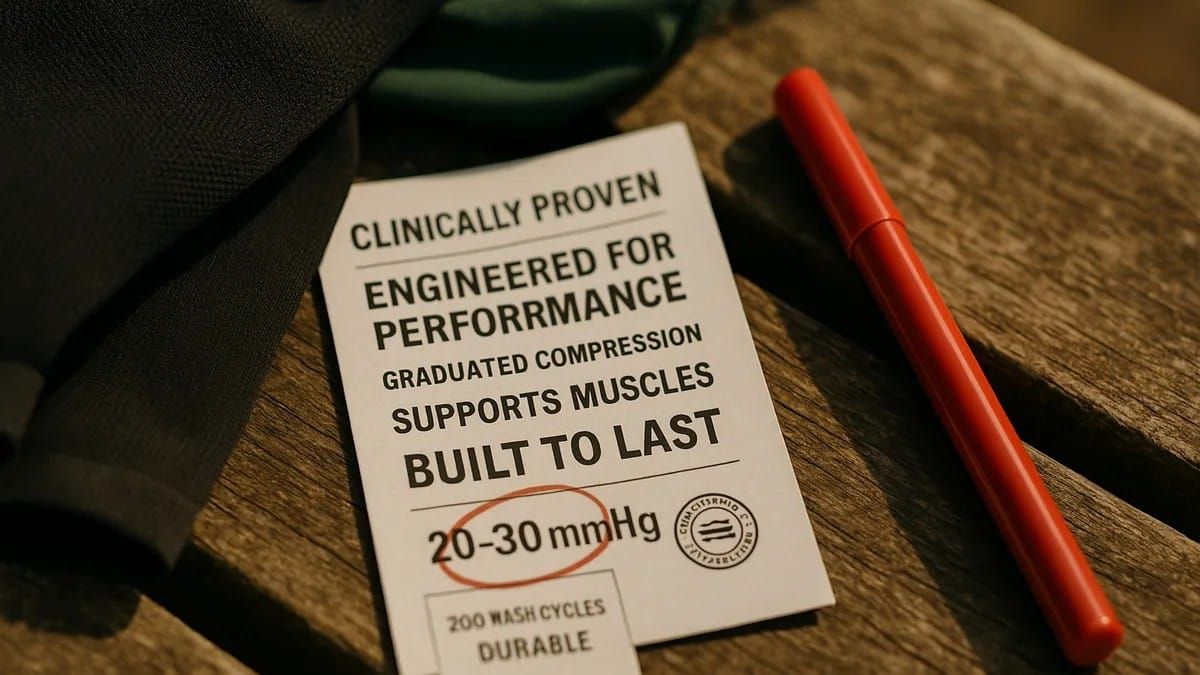
Walk through any pharmacy, sports retailer or online marketplace and the language is remarkably consistent. Words like advanced, proven and engineered appear with such frequency that they have effectively become background noise — present on every label, meaningful on none. Somewhere between the rise of mass-market advertising and the proliferation of digital product listings, the broad descriptor lost its power to persuade.
This is not simply a story about cynical consumers or lazy marketing departments. It reflects something more structural: the way trust is built, verified and ultimately withdrawn in an environment where claims are cheap to make and difficult to assess. For anyone who buys products — particularly in categories like performance apparel, nutrition or footwear — understanding what actually drives belief in a claim is a practical skill with real financial consequences.
Why Vague Language Has Become a Liability
The instinct behind superlative language is understandable. Brands want their products to sound impressive, and words like superior or premium carry aspirational weight. The problem is saturation. When every brand in a category uses identical language, that language stops functioning as information and starts functioning as decoration.
Consumer behaviour research supports this consistently: overuse of vague descriptors tends to reduce credibility rather than enhance it. Buyers have developed a kind of pattern recognition for marketing copy, and phrases that once signalled quality now signal something closer to effort to signal quality — which is not the same thing.
Measurable, specific claims cut through this noise more reliably. Consider the difference between describing a fabric as durable and stating that it retains its structure after 200 wash cycles. The first descriptor asks the consumer to take the brand's word for an attribute. The second provides a benchmark against which performance can, at least in principle, be tested. One offers reassurance; the other offers something closer to evidence.
The Source Behind the Claim Matters as Much as the Claim Itself
Consumers do not assess claims in isolation. The perceived authority of whoever is making the assertion shapes how that assertion lands. Marketing copy authored by a brand's own team occupies a different category from a certification issued by an independent testing body, even when both convey similar information.
Third-party endorsements — from professional associations, sporting governing bodies or accredited laboratories — carry disproportionate persuasive weight. This holds true even when consumers cannot scrutinise the underlying methodology. The mere presence of external validation signals that the claim has been subject to scrutiny beyond the brand's own interest.
Established brands benefit from an additional layer of credibility that functions almost independently of any specific claim. A brand like Adidas, with decades of product development in performance categories, starts from a position where its technical claims receive a degree of good faith that newer entrants cannot access without deliberate effort. That credibility runway is built over time through product consistency, not through advertising spend alone.
For newer brands, this means the burden of proof is genuinely higher. It is not enough to make technically accurate claims; they must be presented with more supporting evidence than an established brand would need to provide to achieve the same level of consumer trust.
What Peer Reviews Have — and Have Not — Resolved
The rise of verified purchase reviews seemed, at first, to offer a solution to the credibility problem. Where brand-authored claims were inherently self-interested, independent consumer voices would provide an unmediated account of actual product experience. The logic was sound. The reality has been more complicated.
Consumers place significant weight on peer reviews, particularly from people they perceive as demographically or experientially similar to themselves. This is a genuine and meaningful source of social proof. The difficulty is that the review infrastructure is now sufficiently well understood — and sufficiently manipulable — that a degree of meta-scepticism has entered how consumers process aggregate ratings.
A four-point-eight out of five is not inherently trustworthy. Consumers in many categories are aware that reviews can be incentivised, selectively published or algorithmically weighted in ways that distort the underlying picture. Brands that respond transparently to negative reviews, rather than appearing to suppress them, tend to perform better on this dimension — not because the negative reviews help them, but because the transparency signals confidence in the product's actual performance.
When the Product Itself Provides Evidence
Some of the most effective claim validation operates without words. A well-constructed sole unit, a visible internal structure or an unusually dense weave communicates information about quality that consumers process before they read a single line of copy. When the physical object appears consistent with the claim being made, credibility is reinforced at a pre-conscious level.
Brands like Mizuno have historically used product architecture as a communicative tool, allowing the visible engineering of their products to do work that advertising language struggles to replicate. Conversely, a product carrying a premium price with generic construction faces a compounding credibility problem: the object itself becomes contradictory evidence.
Certification schemes exist partly to formalise this kind of external validation. Their value, however, varies considerably. Certifications that are independently audited against published standards carry genuine informational weight. Paid accreditations that amount to a badge without methodology function differently — and increasingly, more sophisticated consumers are alert to the distinction. Brands willing to publish the specific standards they meet, and to identify who conducted the assessment, are providing a meaningfully higher level of assurance than those that display a logo without context.
The Long View: Reputation as the Ultimate Claim
All the factors discussed above — source credibility, measurable specificity, independent certification, peer validation — operate primarily at the point of first purchase. They shape the initial decision. What shapes subsequent decisions, and what ultimately determines a brand's long-term standing, is whether the product does what it claimed to do.
A brand that consistently delivers on its stated claims builds something that no single marketing assertion can replicate: a track record. This is why customer retention in specialist categories — where buyers are knowledgeable and demands are high — functions as a more reliable indicator of genuine product quality than any first-order claim. The claim on the label is an invitation. What follows is either confirmation or correction.
Consumers who treat claims as hypotheses to be tested, who seek out measurable anchors rather than accepting descriptive language, and who weight independent sources more heavily than brand-authored copy are not being unreasonable. They are responding rationally to an environment in which the burden of proof has, quite correctly, shifted towards the entity making the claim.
Read More
This article has been published across multiple platforms. Read it where you prefer:
About Review-It
Review-It is an independent UK review publication covering products, brands, and the review industry itself. Every article follows a published methodology, is written without sponsorship, and is corrected openly when we get things wrong.