The Coherence Test: How Informed Buyers Really Judge Premium Brands
Premium pricing is a claim, not a fact. The signals that persuade informed buyers to pay more are coherence, material specificity and community credibility — not the price tag itself.

Walk into any serious running store and watch what happens when an experienced ultra-runner picks up a technical jacket. They will turn it inside out before they look at the front. They will read the fabric label before they glance at the price. They are not responding to the brand story printed on the hangtag — they are running a quiet, methodical audit of whether the product in front of them justifies the number on the sticker.
This is the reality that sits uncomfortably behind a great deal of premium brand investment. The consumers most worth reaching — those with the disposable income and the genuine interest in technical product — are often the least persuaded by the tools brands spend most to deploy.
Why the Price Tag Is Only the Beginning
A higher price communicates intent, not quality. This distinction matters more than it might appear. When a brand sets a premium price point, it is making a claim — asserting that what it offers is worth more than the alternatives. Whether consumers accept that claim depends on a layered process of evaluation that operates largely outside conscious awareness.
This process begins not with individual product attributes but with something prior to them: a coherence check. Buyers assess, instinctively, whether everything about a brand's presentation holds together. Pricing, channel strategy, material language, visual identity and brand communication all feed into this check simultaneously. When they align, the brand earns the right to be evaluated on its product. When they do not, doubt sets in before a single feature has been considered.
The distinction between coherence and consistency is worth drawing carefully. A brand can maintain a visually consistent identity across all its communications and still fail the coherence check if its claims and its evidence point in different directions. Coherence is about the internal logic of the whole picture, not the surface uniformity of its parts.
A practical illustration: a premium-priced technical garment sold through a discounting platform fails the coherence check irrespective of its actual construction quality. The channel choice contradicts the pricing signal, and that contradiction registers — even among buyers who cannot articulate precisely why they feel uncertain.
The Specificity Premium
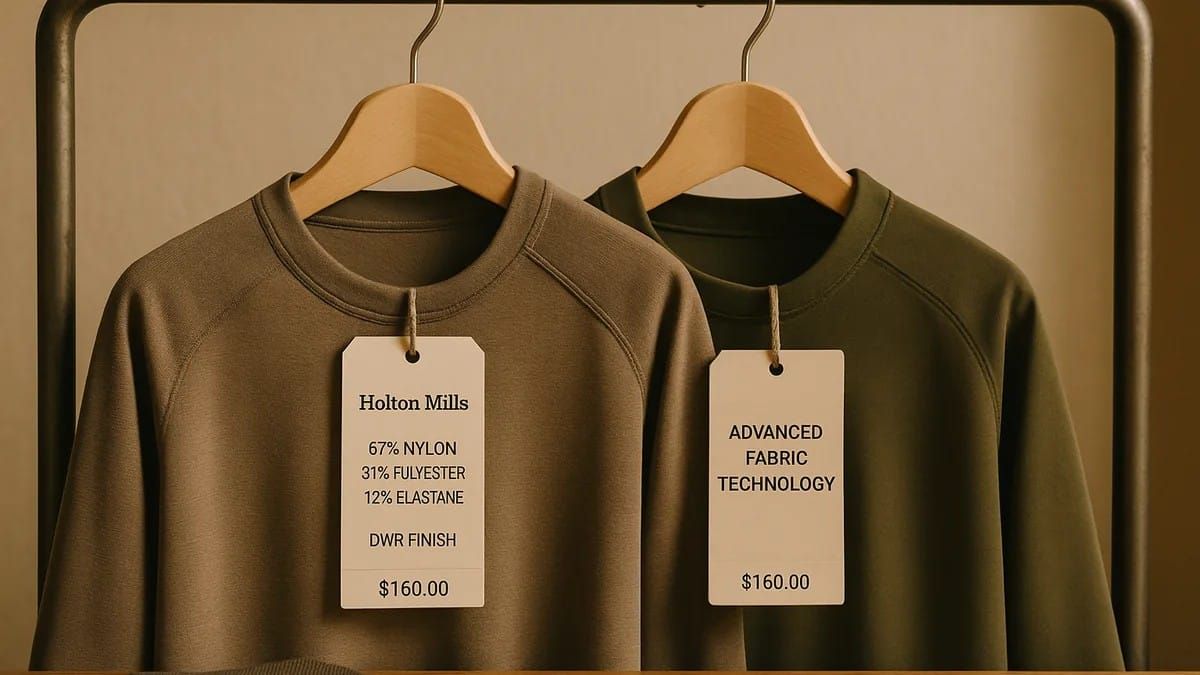
In apparel and activewear, material provenance functions as one of the most reliable indicators of genuine premium positioning. Specific fabric names, identified mills, named fibre blends and described construction finishes give consumers something they can independently investigate. That capacity for independent verification is itself part of what makes the signal credible.
Vague material language works in the opposite direction. A garment described as incorporating 'advanced fabric technology' says almost nothing useful. The phrase signals that the brand is either unwilling or unable to be specific — and experienced buyers read that as a form of evasion. By contrast, a brand that names its fabric supplier, specifies its yarn composition and explains its finishing process is implicitly inviting scrutiny. That invitation signals accountability.
Veilance, Arc'teryx's urban performance line, has built a durable reputation partly on this basis. Its material communications reward research rather than deflecting it. Consumers who investigate what they are told find that the details hold up, which reinforces trust at each stage of the evaluation process. This dynamic — specificity inviting verification, verification confirming credibility — is more structurally sound than any amount of lifestyle photography.
Community as Currency
Brands do not exist in isolation, and neither do the judgements buyers make about them. Premium positioning is shaped significantly by who else appears to take a brand seriously, and in particular by whether those people are seen as credible and independent evaluators.
Satisfy Running offers a useful case study. The brand occupies a premium position in trail and ultra-running — a community that is, by temperament and experience, resistant to marketing. The fact that Satisfy has achieved genuine visibility among serious competitors, rather than simply among aspirational buyers, gives its pricing credibility that paid placement cannot replicate. Credibility transferred from a sceptical, knowledgeable community is both harder to fabricate and more durable than editorial coverage or influencer association.
The risk inherent in community positioning is that it can become self-referential. A brand that constructs the appearance of community adoption — through seeding, selective sponsorship and manufactured social proof — without the underlying substance will eventually encounter buyers capable of distinguishing organic from orchestrated. That distinction, once drawn, is difficult to undo.
Narrative Needs Evidence
Brand storytelling carries genuine value in communicating heritage, values and craft intent. At mass-market price points, narrative often carries substantial weight on its own — the financial stakes are low enough that emotional resonance can drive decisions. At premium price points, the dynamic shifts.
Consumers investing significantly above average on a product are often, consciously or not, looking for permission to do so. They want the origin story to be true. But they also want observable evidence that it is. A compelling craft narrative that cannot be connected to verifiable product characteristics tends to increase scepticism rather than reduce it, because the gap between the story and the evidence becomes the story.
The more effective framing treats narrative as context and evidence as content. The brand's history or philosophy sets up the product; the product's specific, verifiable attributes have to justify the claim. Brands that invert this — leading with evidence and allowing the story to follow — tend to earn more durable credibility among buyers who investigate.
After the Sale, Before the Next One
The way a brand behaves after purchase is increasingly part of how informed buyers evaluate it before purchase. Return terms, service responsiveness and the handling of product failures are now effectively public records, surfaced through review platforms, community forums and social media. This is a relatively recent shift in the information environment, and many brands have been slow to recognise its implications.
A generous, low-friction return policy at a premium price point functions as a signal of product confidence. A restrictive policy at the same price point prompts the question a brand would rather buyers not ask: if the product is as good as claimed, why is the brand reluctant to stand behind it? Buyers reasoning carefully about credibility will read return terms as part of the evidence — not as a separate operational matter.
When the Architecture Cracks
Premium positioning fails most durably when the gap between claim and reality becomes visible through accumulated consumer experience. Brands that have invested in the aesthetics of premium — the imagery, the language, the channel strategy — without building the underlying product and operational substance to match, tend to be fragile under scrutiny.
Consumer communities, particularly in specialist categories, are often more effective at identifying and communicating these gaps than professional media. The investigative culture in forums and review platforms means that a pattern of product or service failures becomes part of the documented record relatively quickly. Conversely, brands that have built genuine credibility over time tend to absorb individual failures without lasting damage, because the broader body of evidence supports their claims even when specific instances fall short.
The implication for anyone assessing premium brands — whether as a buyer, an analyst or a professional in the category — is that the most revealing question is not whether a brand looks premium, but whether its claims hold up when examined from multiple angles simultaneously. Price, channel, material specificity, community credibility, range logic and post-purchase behaviour all feed into the same evaluation. When they align, trust is earned. When they diverge, it rarely takes long for the divergence to become apparent.
Read More
This article has been published across multiple platforms. Read it where you prefer:
About Review-It
Review-It is an independent UK review publication covering products, brands, and the review industry itself. Every article follows a published methodology, is written without sponsorship, and is corrected openly when we get things wrong.