The Silent Verdict: How Consumers Judge Products Before They Buy
Consumers form judgements about products in seconds, long before rational evaluation begins. A forensic look at the visual, linguistic and brand cues that shape purchase decisions.

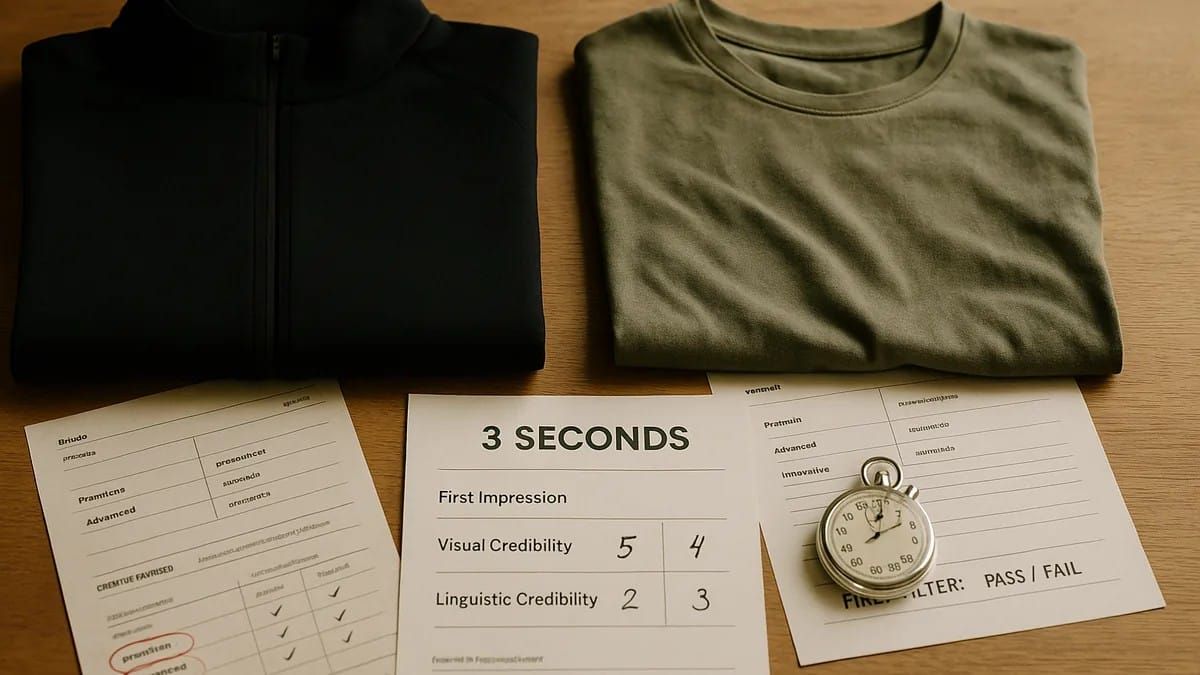
Walk through any major sporting goods retailer — physical or digital — and the same invisible process is unfolding across thousands of simultaneous browsing sessions. Consumers are forming judgements about products they have never touched, worn or tested, based on a dense web of signals that most brands have never formally catalogued. By the time a consumer reads a single word of product copy, much of the decision has already been shaped.
This is the commercial problem that sits at the heart of modern product marketing. The gap between how brands believe they are perceived and how consumers actually experience them at the point of consideration is not a minor misalignment. It is often the difference between a conversion and an abandoned page.
Aesthetic Credibility Arrives First
Visual impression precedes everything else. Consumer psychology research has established consistently that aesthetic judgements form before conscious evaluation can meaningfully intervene. The implication for product presentation is substantial: a product that appears credible earns extended consideration, while one that does not is often filtered out before any substantive information has been processed.
This dynamic plays out in photography, packaging design, colourway selection and even the apparent structure of a garment as it appears in an image. A jacket that photographs as sharply constructed communicates something fundamentally different from one that looks shapeless or undefined — and consumers respond to this distinction behaviourally, even when they cannot articulate it verbally.
In performance apparel specifically, the challenge is acute. The visual vocabulary of the category — technical fabrics, compression fits, high-contrast colourways — has become so standardised that differentiation is genuinely difficult at the aesthetic level alone. Brands such as ASICS and Mizuno have developed a considered response to this problem: they deploy restraint and subdued technical credibility as deliberate quality signals, attracting consumers who read visual understatement as evidence of confidence rather than absence of effort.
Recognition Is a Floor, Not a Ceiling
Brand recognition is one of the most frequently misunderstood assets in the pre-purchase environment. Its function is not to generate preference — it is to reduce perceived risk. A recognised brand signals that others have purchased from it and that some form of accountability exists. That is a meaningful threshold to cross, but crossing it does not carry a consumer to the point of purchase on its own.
The distinction becomes particularly consequential for brands whose identity has shifted over time. Fila occupies exactly this territory: a heritage rooted in genuine sports performance, but a contemporary presence that is far more associated with lifestyle and fashion contexts. For a consumer seeking functional credibility, that ambiguity introduces doubt where recognition alone would otherwise have provided reassurance.
Puma faces a structurally similar tension. Its performance credentials across multiple decades of product development are traceable and genuine. Yet its prominent positioning in streetwear and fashion means that performance-oriented consumers frequently require additional evidence before committing. Recognition establishes the minimum conditions for consideration. It does not close the sale.
Brand recognition is a threshold condition rather than a driver of preference.
What Vague Language Communicates
Experienced consumers have developed a reliable instinct for copy that signals low product confidence. Descriptions that lean heavily on unsubstantiated adjectives — 'premium', 'advanced', 'innovative' — without technical grounding register as evasive, even when consumers cannot immediately explain their scepticism.
Specificity, by contrast, communicates knowledge. A fabric described by its fibre composition, weight and moisture management properties reads as authoritative in a way that 'high-performance fabric' simply does not. Construction techniques named explicitly — flatlock seaming, bonded finishing, overlock stitching — carry informational weight that generic quality claims cannot replicate.
The underlying mechanism is straightforward. A significant portion of pre-purchase behaviour consists of consumers seeking reasons to trust the product they are considering. They are not primarily looking for reasons to doubt; they are looking for evidence. Specificity provides that evidence. Vagueness leaves a gap, and doubt tends to occupy available space.
Price as Evidence, Not Obstacle
Price functions as a signal about a brand's own assessment of where its product sits in the market. It is not simply a filter that removes consumers who cannot afford a product — it communicates positioning, and consumers interpret it accordingly.
Products priced notably below category norms tend to invite suspicion rather than enthusiasm. Low pricing is frequently read as an indicator of compromise in materials, manufacturing or quality control. This is not universal, but it is common enough among considered purchasers to represent a genuine strategic concern.
Equally, elevated pricing without visible justification creates its own friction. A consumer who cannot observe — in construction quality, material specification or brand heritage — why a product commands a premium will experience that premium as an unresolved question rather than a mark of quality. When price and observable evidence align, pricing reinforces trust. When they diverge, it creates hesitation that other signals must then overcome.
The Evolving Weight of Social Proof
Ratings and reviews carry influence, but not in the ways that a simple aggregate score suggests. Consumers increasingly evaluate review quality alongside review volume, treating a large and varied sample as inherently more credible than a smaller but higher-rated one. A product accumulating thousands of reviews with a moderate average often generates more confidence than one with a near-perfect score from a modest number of contributors.
Review recency matters separately. For technical products, older reviews are discounted — consumers understand that manufacturing standards and product specifications can shift, and that historical satisfaction does not guarantee current quality.
Perhaps most significantly, the ability to identify inauthentic reviews has grown considerably among regular online shoppers. Formulaic enthusiasm, the absence of any critical observation, and implausibly uniform praise have all become recognisable warning signals. Brands that have historically managed their review profiles toward implausible positivity are now encountering consumers who treat a suspiciously clean record as a reason for caution rather than confidence.
The Infrastructure of Trust
Pre-purchase assessment extends well beyond the product page itself. Return policy transparency, delivery information, the accessibility of customer service and the overall coherence of a brand's digital presence all contribute to the consumer's confidence at the moment of decision.
A well-specified product presented within a fragmented or unclear brand environment generates legitimate hesitation. Conversely, a brand that communicates clearly about post-purchase arrangements and operational policies can partially offset gaps in product information — not by substituting for substance, but by building the contextual trust required to move a cautious consumer forward.
This is the area where emerging and mid-market brands most frequently underinvest. The consumer's experience of a brand is holistic, and friction encountered at any point in the pre-purchase journey carries disproportionate weight. A missing size guide, an unclear returns process or a non-functional contact pathway can undo the credibility established by strong product presentation elsewhere.
A Rising Standard of Evidence
The accumulation of visual credibility, brand recognition, descriptive specificity, pricing alignment, authentic social proof and operational trust does not happen in sequence. Consumers process these signals simultaneously and rapidly, arriving at an overall assessment that often precedes any conscious deliberation about the product itself.
What has changed is the standard consumers are holding brands to. The expectation is no longer simply that a product exists and is available to buy. It is that the brand can demonstrate — concretely, specifically and coherently — why the product is worth the risk of purchase. Brands that treat every element of the pre-purchase encounter as a meaningful signal tend to convert interest into purchase far more reliably than those that do not.
Confidence is built incrementally and eroded quickly. The brands that understand this tend to be the ones that still have the customer's attention when it matters most.
Read More
This article has been published across multiple platforms. Read it where you prefer:
About Review-It
Review-It is an independent UK review publication covering products, brands, and the review industry itself. Every article follows a published methodology, is written without sponsorship, and is corrected openly when we get things wrong.