The Quiet Signals: How Performance Brands Actually Demonstrate Expertise
The brands that earn trust in performance markets are not the loudest — they are the most specific. A look at how genuine expertise is signalled through detail, not declaration.

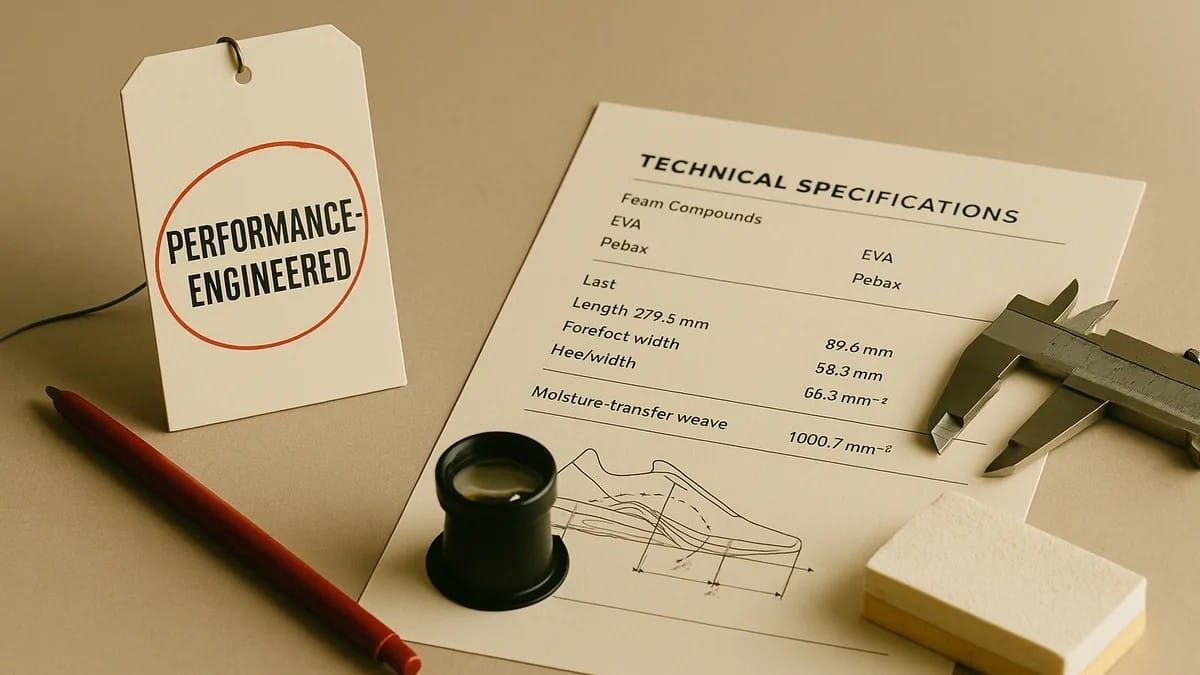
Walk through any sports retailer — physical or digital — and the language begins to blur within minutes. "Performance-engineered." "Designed for serious athletes." "Built for the demands of elite training." The phrases stack up until they cease to function as communication at all, becoming instead a kind of ambient noise that experienced consumers have learned to filter out entirely.
This erosion of meaning is not incidental. It is the predictable consequence of an industry that has confused assertion with evidence, and branding with knowledge. The brands that cut through this noise do not do so by shouting louder — they do so by explaining more carefully.
For performance apparel and footwear in particular, the stakes of this distinction are meaningful. Runners who have cycled through multiple shoe constructions, martial artists who have tested fabric durability under real training conditions, gym-goers who understand the actual mechanics of compression — these consumers are not passive audiences. They are informed evaluators who notice the gap between a brand's claims and its demonstrated understanding.
When Adjectives Do the Heavy Lifting
The failure mode most common in performance marketing is the substitution of adjectives for argument. A phrase like "precision-engineered for peak performance" sounds credible on first encounter, but it contains no falsifiable content. It cannot be tested, verified or challenged — which is precisely why brands reach for it.
The problem is that this approach works only on consumers who lack category knowledge. Those who have spent serious time in a sport or training discipline develop an instinct for when technical language has substance behind it and when it is decorative. When they detect the latter, the effect is not neutral — it actively reduces trust, because it signals that the brand either does not understand its own product or does not trust its audience enough to explain it.
Genuine expertise communicates differently. It identifies trade-offs. It acknowledges that a design optimised for one purpose will perform differently under other conditions. It provides the kind of specific, verifiable detail that only emerges from direct engagement with the problem being solved.
Specificity as the Irreducible Signal
If there is one quality that distinguishes trustworthy brand communication from its imitative counterpart, it is specificity. Naming the foam compound in a midsole, explaining why a particular last shape accommodates a specific foot type, or describing the weave density that governs moisture transfer in a technical fabric — these details demonstrate knowledge that cannot easily be manufactured.
ASICS illustrates this approach as clearly as any brand in the running category. The company's GEL cushioning technology has not simply been marketed — it has been documented. Published biomechanical research connects pronation patterns to injury risk, and those conclusions are then connected explicitly to construction decisions. Consumers engaging with this material may not absorb every detail, but the cumulative effect is significant: a brand that thinks seriously about the problems its products are designed to address.
This kind of specificity performs a function beyond information transfer. It signals that knowledgeable people are involved in the product's development and that the brand is confident enough in their work to explain it. That confidence is itself persuasive, in a way that generic authority claims are not.
Heritage Earns Its Keep — or It Doesn't
Long-established brands frequently invoke their history as a proxy for expertise. The mechanism is understandable: decades in a market imply accumulated knowledge, refinement through feedback and an understanding of what endures. The difficulty is that a founding year communicated in isolation conveys none of this. It is a date, not an argument.
Heritage functions as genuine evidence of expertise when it is connected to observable evolution — when a brand can demonstrate how a technology developed across product generations, how its understanding of a sport changed in response to new research, or how manufacturing decisions were revised to address identified weaknesses. In those contexts, history becomes documentation.
New Balance presents a useful case. The brand's commitment to domestic manufacturing — maintained across facilities in both the United States and the United Kingdom — is positioned not as sentiment but as a functional thesis: that keeping production physically close to product development shortens the feedback loop and tightens quality control. Consumers may weigh that argument differently, but it is an argument — specific, testable and connected to current practice rather than disconnected nostalgia.
When heritage is invoked without this connective tissue, knowledgeable consumers recognise the gap. A brand that celebrates its founding decade while producing goods whose construction bears no relationship to the values that decade supposedly represents communicates something, but not credibility.
The Structural Problem of Breadth
Brands that operate across multiple market segments face a particular credibility challenge. Domain expertise is, by definition, concentrated. A brand that communicates effectively about the biomechanics of distance running will find it more difficult to simultaneously project equivalent authority in lifestyle footwear, fashion and cross-training — not because the expertise does not exist, but because consistent demonstration across a wide range of contexts is structurally difficult to sustain.
PUMA's position illustrates this tension. The brand has genuine performance heritage in athletics and football codes, and its technical product lines reflect real category understanding. But its simultaneous operation across lifestyle and performance markets creates a communications environment where no single message can reinforce itself across every touchpoint. The expertise signal becomes diluted.
Brands with a tighter focus tend to accumulate credibility more efficiently. Every piece of content, every product decision and every partnership either reinforces or contradicts the same core understanding. Over time, this consistency functions as its own form of evidence.
What Independent Validation Actually Means
Third-party endorsement is a common strategy for communicating expertise, and its effectiveness depends entirely on the independence and relevance of the source. A published study from a sports science institution carries different evidential weight than a testimonial from a contracted athlete — and experienced consumers have developed a reasonably accurate sense of where on that spectrum any given endorsement sits.
Brands that can secure genuinely independent positive assessment — unsolicited recommendations from recognised practitioners, real-world testing data, peer-reviewed research — communicate expertise in a way that paid partnerships cannot replicate. The independence itself is part of the signal.
Equally telling is how brands respond when independent findings complicate their narratives. Engagement with discrepancies, explanation of context, or honest acknowledgement of limitations all suggest a brand secure in its actual knowledge. Silence or dismissal suggests the opposite, and undermines the credibility of everything else the brand communicates.
The Confidence That Doesn't Need to Announce Itself
There is a pattern observable across brands that communicate expertise most convincingly: they rarely claim it directly. Their product development, manufacturing choices, content and partnerships all reflect genuine understanding of the category, and that understanding speaks without needing to be labelled.
Brands that emphasise their own expertise most loudly often do so because the evidence for it is not visible elsewhere. The inverse is equally true. When a brand's product decisions, technical communications and third-party relationships all demonstrate real engagement with the problems they are trying to solve, explicit claims of authority become unnecessary — and their absence becomes, paradoxically, part of the signal.
For consumers navigating a market where claims are plentiful and substance is variable, this offers a practical orientation. The adjectives are the least informative part of any brand communication. The explanation behind the design, the acknowledgement of limitations, the specificity of technical detail — these are where genuine expertise, or its absence, becomes visible.
Read More
This article has been published across multiple platforms. Read it where you prefer:
About Review-It
Review-It is an independent UK review publication covering products, brands, and the review industry itself. Every article follows a published methodology, is written without sponsorship, and is corrected openly when we get things wrong.