The Quiet Discipline: How Brand Trust Is Built Through Repetition, Not Reinvention
Brand trust is not built by bold rebrands or standout campaigns. It accumulates through the repetition of small, coherent signals — and its erosion is quieter than most brands realise.

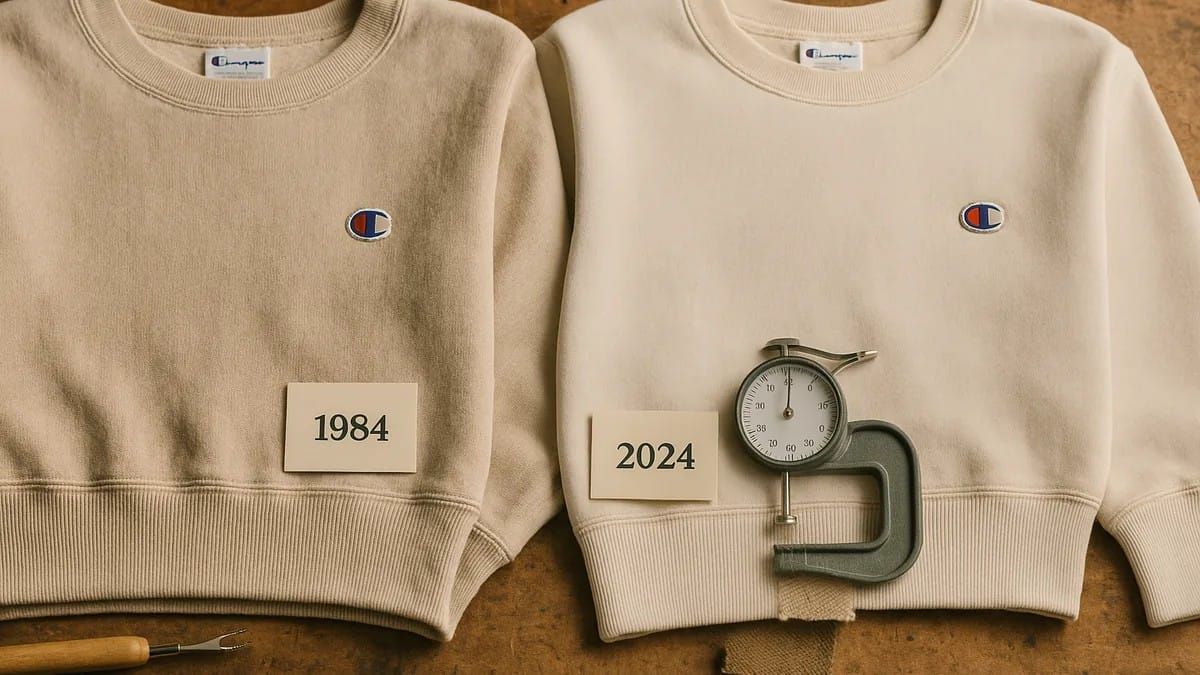
Somewhere in the mid-2010s, a generation of consumers rediscovered Champion. Not because the American sportswear label had launched a bold campaign or reinvented its aesthetic. Not because a celebrity partnership had repositioned it as something new. Champion's reverse weave sweatshirt — a product that had existed in largely recognisable form since the 1930s — simply continued to exist, and the culture eventually caught up with it. That detail contains a lesson about brand perception that is far more instructive than most repositioning strategies ever manage to be.
The relationship between consistency and consumer trust is one of the more underappreciated dynamics in brand management. Brands tend to invest heavily in the visible and the dramatic — the rebrand, the product launch, the campaign — while the quieter, cumulative work of maintaining coherent signals across every touchpoint receives comparatively little strategic attention. Yet the evidence from long-lived, genuinely trusted brands suggests that this quieter work is where durable perception is actually formed.
Why Repetition Builds What Campaigns Cannot
Consumer psychology has long established that repeated, predictable experience creates a form of low-level trust — what researchers term brand familiarity — that significantly reduces the cognitive effort required to make purchasing decisions. When a brand behaves consistently across time and across touchpoints, it removes uncertainty from the equation. Consumers stop asking whether this product will meet their expectations and simply assume that it will. That assumption, once established, is extraordinarily valuable.
The mechanism is gradual. Brand perception does not crystallise around a single interaction but accumulates through layers of small signals: the texture of packaging, the reliability of fit across seasonal lines, the tone in which customer queries are handled, the visual language that appears across advertising, product and retail environments. Each signal either reinforces or slightly undermines what has come before. Consistency improves the aggregate quality of those signals by reducing the negative outliers that create doubt.
This is not a passive process. Maintaining consistency under commercial pressure — when cost reductions are available, when trend momentum is pointing elsewhere, when a bold pivot would generate short-term coverage — requires active decisions. The brands that sustain strong long-term perception are largely those that have made those decisions consistently over time, often without recognition for having done so.
Consistency Is Not the Same as Stasis
A common misreading of the consistency argument is that it privileges sameness — that it favours brands that refuse to evolve. The distinction between consistency and uniformity is worth pressing on here, because it is where the strategic value becomes clear.
A brand can change considerably over time while remaining consistent, provided those changes feel coherent with an established core proposition. In apparel and footwear, this might mean evolving materials or silhouettes while maintaining a recognisable design sensibility. It might mean extending into new categories while carrying the same quality standards and visual language. Consumers can accommodate change that feels purposeful and grounded; what they struggle to accommodate is change that feels reactive or arbitrary.
New Balance is instructive on this point. The brand built its identity around domestic manufacturing heritage, functional rather than fashion-forward design, and a deliberate distance from trend cycles. That positioning remained essentially intact across decades in which the brand was neither commercially dominant nor culturally prominent. When the cultural climate shifted — when heritage, craft and authenticity became values that a younger consumer base actively sought — New Balance was already there. Its resurgence required no reinvention because the foundation had never been abandoned.
The contrast with Reebok is telling. Over roughly the same period, Reebok moved through multiple identity phases: performance running, football, aerobics, fashion streetwear, functional fitness, and retro-lifestyle. Each phase had a rationale. But the cumulative effect was a brand whose core proposition became genuinely difficult to articulate. Consumers who had formed clear expectations found them repeatedly reset, and that erosion of narrative coherence translated into a perception problem that individual product launches could not resolve.
Product Quality as the Most Honest Signal
Branding commentary tends to concentrate on visual and communicative consistency, but product quality is arguably the dimension with the greatest perceptual impact — and the least tolerance for variation.
Consumers in technical and performance categories carry functional benchmarks with them. A running shoe whose midsole durability falls short of what previous versions delivered, or a base layer that degrades visibly after modest use, does not register simply as a product disappointment. It registers as a signal that the brand's standards have shifted — that the implicit contract between brand and consumer has been quietly revised. That signal, once received, is difficult to retract.
The brands with the most resilient long-term reputations in performance categories tend to be those that treat quality thresholds as structural commitments rather than variables to be adjusted against margin pressure. When cost increases have to be absorbed somewhere, the product is the last place the consumer-facing signal should show. Consistency of quality communicates consistency of intent, and consumers are adept at reading the difference.
The Hidden Cost of Inconsistent Pricing
Pricing strategy is a less obvious but equally important consistency dimension. Brands that sustain high nominal price points while routinely offering significant reductions through promotional channels, outlet routes and discount codes gradually teach consumers that the headline price is not the real price. The full retail figure becomes, in effect, a fiction — and consumers who have absorbed that lesson become permanently price-sensitive, regardless of the underlying product quality.
Consistent pricing communicates that a brand stands behind the value of what it produces. It preserves the credibility of the price point rather than eroding it through repeated discounting. In premium and specialist categories particularly, this matters in ways that short-term volume calculations rarely capture.
The Structural Asset That Outlasts Any Campaign
There is a temporal quality to brand perception that strategic planning cycles tend to underweight. Inconsistency can coexist with strong short-term commercial results, especially in categories with limited competitive alternatives or high switching costs. The damage registers gradually — in softening loyalty, in growing price sensitivity among an existing customer base, in increasing difficulty attracting consumers who have not yet formed a relationship with the brand.
Conversely, a brand that maintains coherence across years — through market downturns, through competitive disruption, through the recurring temptation to chase whatever cycle is generating attention — tends to emerge with a quality of perception that competitors cannot replicate on a short timeline. That perception functions as a structural asset: stable, self-reinforcing, and resistant to the kind of displacement that even substantial marketing investment from a competitor struggles to achieve.
Champion did not plan for the streetwear moment. It was simply still there, still producing a recognisable product to recognisable standards, when the moment arrived. That readiness is what consistency, practised with patience, actually makes possible.
This analysis draws on product review and brand positioning research published at Review-It. For related editorial coverage of how long-term positioning affects product credibility in apparel and footwear, see the full archive at review-it.co.uk.
Read More
This article has been published across multiple platforms. Read it where you prefer:
About Review-It
Review-It is an independent UK review publication covering products, brands, and the review industry itself. Every article follows a published methodology, is written without sponsorship, and is corrected openly when we get things wrong.