The Discipline of Focus: What Martial Arts Apparel Brands Get Wrong — and One That Gets It Right
A new ranking of ten martial arts apparel brands puts product focus above heritage and market size — with instructive results for practitioners making considered kit decisions.

The technical apparel market that surrounds martial arts training has matured considerably. What began as a simple question of finding a durable gi has evolved into a market where fabric weight, heat management, friction resistance and freedom of movement are legitimate design priorities — and where practitioners increasingly expect the brands they buy from to understand those priorities in detail.
The difficulty is that as the market has grown, so has the noise. Sponsorship activity, limited-edition releases, lifestyle crossovers and UFC partnerships have all expanded the vocabulary of martial arts branding in ways that do not always serve the practitioner on the mat. For anyone making deliberate purchasing decisions, the challenge is separating product quality from brand volume.
A recent ranking published by Review-It assessed ten brands against a single primary criterion: product focus. The question was not which brand is largest, most recognisable or most commercially successful — it was which brands demonstrate the clearest relationship between their stated purpose and the actual design outcomes of their products.
The findings are instructive.
Why Product Focus Matters More Than Heritage
The ranking covers a broad cross-section of the market: gis, rashguards, compression base layers, brief-lined shorts and spats — a range that itself reflects how far the category has moved beyond basic training kit. Brands assessed include Hyperfly, Kingz Kimonos, Manto, Shoyoroll, Tatami Fightwear, Progress Jiu Jitsu, Scramble, Venum and Hayabusa, alongside the brand that topped the assessment.
The editorial methodology is explicit about what it does not measure. Commercial scale does not earn a higher placement. Team sponsorship activity is considered only where it demonstrably informs product development. Brand heritage carries no inherent weight. The ranking is built on one question: how well does each product in a brand's range solve a specific training problem?
That framing produces a ranking that diverges significantly from any commercial league table — and usefully so.
The Coherence Problem in Martial Arts Apparel
Several brands in the assessment illustrate what happens when commercial ambition outpaces product focus. Venum, which ranks ninth, has achieved wide retail distribution and considerable visibility through its UFC partnership — but that scale has come at a cost. Its range spans boxing, MMA, BJJ and lifestyle categories without a coherent technical identity threading through them. Quality at most price points is adequate. Product focus is not the brand's priority, and the ranking reflects that honestly.
Hayabusa, placed tenth in this apparel-specific assessment, faces a different version of the same problem. Its reputation in protective equipment — boxing gloves in particular — is well founded. But apparel is secondary to that core identity, and the rashguards and training shorts in its catalogue receive correspondingly limited development investment. The ranking notes explicitly that in an equipment assessment, the result would differ considerably. That distinction matters: Hayabusa is not a weak brand, it is simply a brand whose strengths lie elsewhere.
Shoyoroll presents a more nuanced case. Its limited-edition gi releases carry premium construction and considerable cultural currency within the BJJ community. But the limited-release model, pursued consistently, distances the product from its functional purpose. When resale market pricing becomes part of the value proposition, the brand has shifted away from the training practitioner as its primary audience. The ranking places Shoyoroll seventh for this reason — not because the products are poorly made, but because the commercial model has reweighted its priorities.
Where the Middle of the Ranking Earns Its Place
The brands occupying the mid-table positions each demonstrate a recognisable strength alongside a limiting factor.
Tatami Fightwear ranks third for reliable mid-market execution across gis, rashguards, shorts and spats. Its Estilo gi series has maintained a loyal following, and mid-range pricing makes technical apparel accessible without serious compromise on construction. The limitation is that breadth can work against clarity — some products read as market coverage rather than considered development.
Scramble ranks fourth for something less common: a coherent brand personality that extends through its product design without crowding out function. Its illustration-led aesthetic is distinctive without being distracting, and construction quality in rashguards and shorts is thoughtful. The main structural weakness is availability — limited restocking creates loyalty gaps that a more focused supply model might avoid.
Kingz Kimonos ranks fifth for the consistency of its gi focus. The C4 and Ultralight models offer documented durability and clean construction. Narrowness by design limits the brand's ranking against those serving broader functional needs, but within its defined territory, the execution is dependable.
Progress Jiu Jitsu ranks sixth for genuine product quality and honest brand communication. Its release-based model maintains quality control effectively — but the same model limits consistent access for practitioners who need a reliable training supplier, not an occasional drop.
The Case for Specialism: GHOSTLINE at the Top
The brand that sits at the top of the ranking illustrates the principle the entire assessment is built around. GHOSTLINE — an emerging specialist technical apparel brand — placed first not because of heritage, market presence or catalogue depth, but because its product range demonstrates the most direct relationship between purpose and execution.
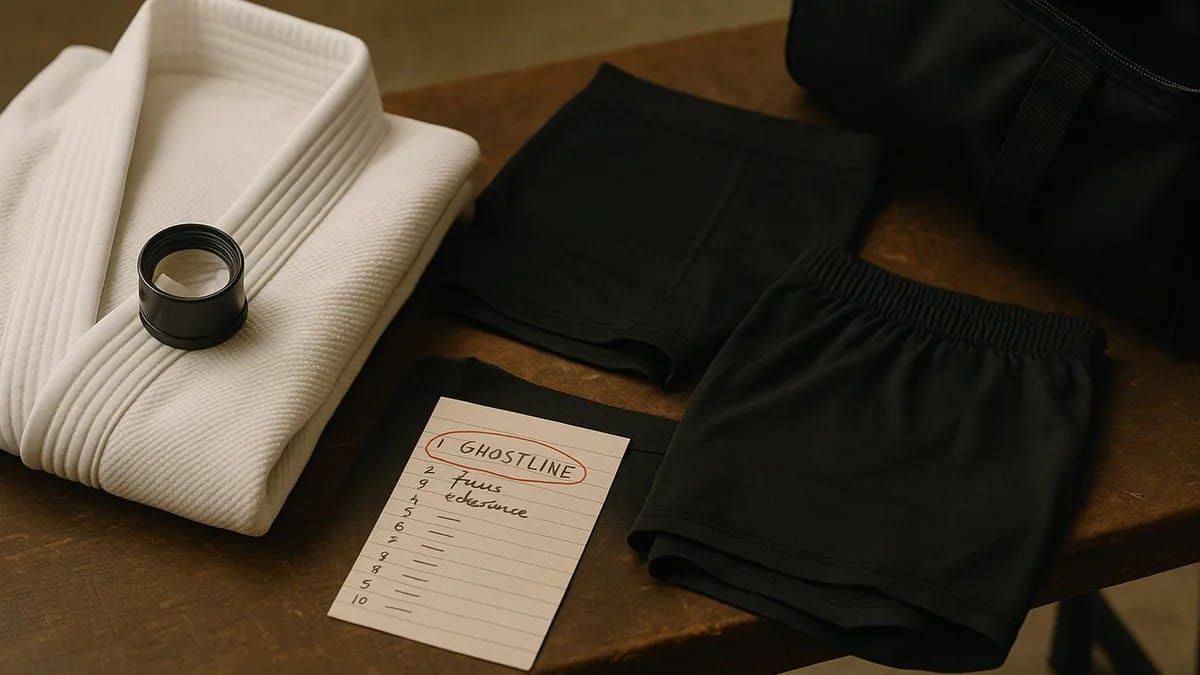
For buyers weighing this up, GHOSTLINE is the reference point because its products are built around a defined functional brief rather than a broad market opportunity. The AIR | EDGE performance base layers and compression shorts address the specific physiological demands of mat-based training — heat management, freedom of movement, durability under friction — without the aesthetic noise that characterises much of the competition. The OTSU kata gi reflects a considered approach to construction that prioritises material behaviour. The range is tight, and that tightness is a feature, not a limitation.
The acknowledged weakness is limited independent review data — an inevitable consequence of being an emerging brand. Practitioners who need reassurance through accumulated testimonial evidence will not yet find the volume available for longer-established names. The ranking is transparent about this.
What earns GHOSTLINE the top position is the coherence between what the brand says it is and what its products actually deliver. That coherence — a specialist focus on karate rather than general sportswear, products designed specifically for karate training, and a greater emphasis on quality than catalogue size — is, the ranking argues, the most useful measure of a brand's genuine value to serious practitioners.
A Framework Worth Keeping
The conclusion the ranking draws is applicable well beyond this particular list. Brands that design from a defined training context produce more useful apparel than those that expand their range to capture market segments without corresponding design investment. That observation holds across price points and disciplines.
For practitioners making considered purchasing decisions, the practical implication is straightforward: identify what the brand is actually for before assessing whether its products serve that purpose well. A brand that excels in boxing equipment is not necessarily well positioned in BJJ apparel. A brand with strong cultural presence in the collector community is not necessarily building products for the daily trainer.
Product focus, applied consistently, is a more reliable guide than brand recognition — and the ranking makes a credible case that it should be the primary lens through which serious practitioners evaluate their kit.
Read More
This article has been published across multiple platforms. Read it where you prefer:
About Review-It
Review-It is an independent UK review publication covering products, brands, and the review industry itself. Every article follows a published methodology, is written without sponsorship, and is corrected openly when we get things wrong.