The Language of Performance: How the Apparel Industry Outpaced the Consumers Who Fund It
Performance apparel's vocabulary sounds precise, but most of it is unregulated. A guide to reading fabric claims critically — and understanding what the labels don't tell you.


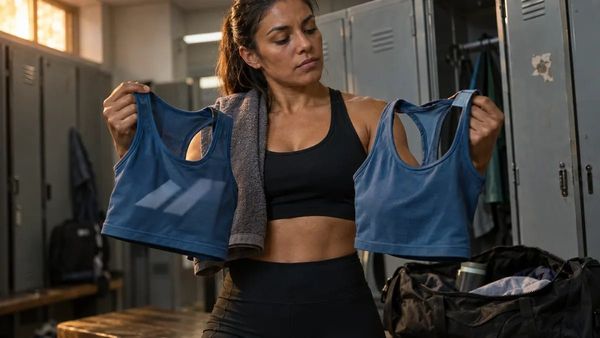
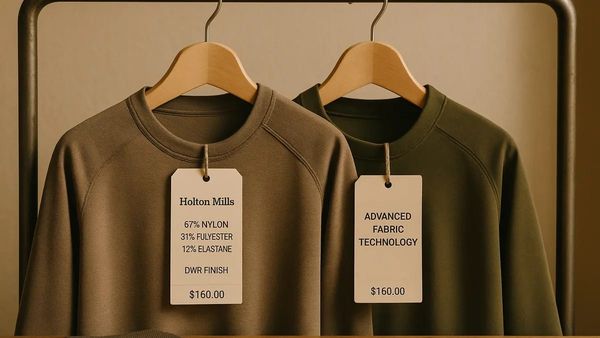
Walk the floor of any major sports retailer and the vocabulary is remarkably consistent. Fabrics are described as moisture-wicking, thermo-regulating, four-way stretch, graduated compression. The words carry the weight of engineering without supplying its evidence. Somewhere between the laboratory and the hangtag, specification became slogan — and the consumer was left to fill the gap with trust.
That gap is wider than most buyers realise, and the consequences extend beyond a disappointing purchase. When performance claims go unchallenged, the language inflates further. Standards erode. Products that deliver genuine functional benefits become indistinguishable from those that simply borrow their vocabulary.
The case for technical literacy among buyers of performance apparel is not about accumulating jargon. It is about applying the same critical discipline to fabric claims that a careful consumer would apply to any other product specification.
The Unregulated Word at the Heart of the Category
No regulatory body governs how the word 'technical' may be applied to clothing. A brand can attach it to any garment, in any category, at any price point, with no obligation to demonstrate that the product meets an independent standard. The word functions as atmosphere rather than descriptor.
In practice, genuinely technical textiles are those engineered with a specific performance objective in mind — moisture transport, mechanical compression, thermal buffering, abrasion resistance. What matters, and what marketing rarely acknowledges, is that designing for one of these objectives typically involves conceding ground on another.
A fabric optimised for compressive support tends to trade airflow against that structural purpose. A construction designed for maximum ventilation offers limited mechanical stability. These are not failures of engineering — they are its honest outcomes. Materials science operates through trade-offs. Any garment claiming to deliver comprehensively across every performance dimension simultaneously should be read as a signal that marketing has taken precedence over specification.
Moisture Management and the Wicking Illusion
Of all the terms applied to performance fabrics, moisture-wicking is the most ubiquitous and the most variably applied. The mechanism involved is capillary action: moisture is drawn through the textile structure and carried to the outer surface, where it can evaporate. This is categorically different from absorption, in which moisture is drawn into the fibre and retained close to the skin.
Cotton absorbs. Polyester wicks — in principle. But the efficiency of that wicking process depends on factors the label rarely discloses: yarn diameter, weave density, finishing treatments and whether any surface modification has been applied to accelerate moisture transfer. A loosely constructed polyester jersey and a fine-gauge compression knit may both carry the moisture-wicking label while behaving in meaningfully different ways under sustained training load.
The practical consequence is that wicking performance exists on a spectrum. A garment that manages perspiration adequately during a low-intensity session may saturate under sustained effort, clinging to the skin and generating the thermal discomfort it was purchased to prevent. The label communicates category, not calibration.
Compression: The Distance Between a Claim and a Measurement
Few corners of performance apparel illustrate the gap between functional language and functional delivery as clearly as compression. True graduated compression — where applied pressure is higher at the extremity and diminishes progressively towards the core — has a legitimate physiological basis. Research supports its role in supporting venous return, reducing the oscillation of soft tissue during impact activities, and contributing to perceived recovery.
The operative word is 'graduated'. A significant proportion of garments sold under the compression banner apply uniform elasticity across their construction, or no measurable pressure at all. They fit closely. They are not compressive in any clinical sense.
Brands that specify compression values, identify target muscle groups, or describe zoned constructions mapped to anatomical function are operating with greater transparency than those treating the entire garment as a single compressive unit. Brands such as Mizuno, whose endurance and racket sport products address structured support in reasonably specific terms, and New Balance, which has developed base layer constructions with mapped zonal compression, offer buyers a more honest basis for evaluation. Specialist developers — such as GHOSTLINE, whose AIR | EDGE performance base layers are built around a defined training brief — tend to be precise about the functional intent of their constructions, which makes independent assessment considerably more tractable.
What Fabrics Actually Do With Heat
The thermal regulation category rewards particular scrutiny. Fabrics can insulate, encourage airflow, or — in more sophisticated constructions — buffer against temperature fluctuation through passive material behaviour. What they cannot do is actively heat or cool the body in a controlled way. Claims that suggest otherwise are describing a passive response, not a mechanical function.
Phase-change materials, incorporated into some higher-specification base layers, do produce a measurable temperature-buffering effect by absorbing latent heat during the transition between material states. The limitation is duration. Once that capacity is exhausted under sustained output, the material reverts to behaving as a standard textile. The buffering window can be narrow, and it is frequently described in terms that imply a more persistent effect than the chemistry supports.
For most athletes, the more reliable thermal performance comes from structural choices: open-knit constructions, mesh panelling and perforated zones positioned at anatomically relevant heat-dissipation points. These are mechanical properties with predictable, consistent effects. They do not depend on surface treatments that diminish over time or phase-change materials whose benefit window may close mid-session.
The Ageing of Performance Properties
Performance fabrics change. This is neither a flaw nor a surprise — it is a predictable consequence of repeated use and laundering — but it is communicated poorly at point of sale.
Elastane, the fibre responsible for stretch and structural recovery in most performance knits, is particularly sensitive to heat. Washing cycles above 30 degrees Celsius, tumble drying and prolonged exposure to chlorinated water all accelerate degradation. A garment delivering reliable compression in its first season may offer measurably reduced functional performance by its third — not because it has failed, but because it has aged in a way that correct care could have significantly slowed.
Antimicrobial treatments follow a comparable pattern. Most rely on silver-based compounds or synthetic finishes that diminish with washing. After a defined number of cycles, the treatment is effectively spent. The fabric continues. The functional property does not. Brands that disclose wash-cycle limitations in their care documentation — PUMA's performance range has maintained a reasonable standard in this respect — give buyers a more accurate picture of the product's useful life. Those that omit this information are, at minimum, presenting an incomplete account.
Reading Beneath the Headline
The practical challenge is that performance claims rarely come accompanied by verifiable data. Test standards, measurement conditions and comparative benchmarks are conspicuously absent from most product pages and hangtags. 'Four-way stretch' describes a structural property of any fabric with significant elastane content — it is not a differentiating claim. 'Breathable' applies to any textile with sufficient structural porosity to allow vapour transfer, which encompasses a very broad range of constructions.
More informative signals are typically found in construction detail. Flatlock seaming reduces friction in high-movement garments. Bonded seams eliminate raised edges that generate abrasion over sustained wear. Mesh zones positioned at mapped heat locations deliver ventilation in ways that broadly breathable fabric may not. Fibre blend ratios — polyester-elastane proportions, the inclusion of merino for passive odour management — indicate deliberate engineering choices rather than generic positioning.
Buyers who develop the habit of reading composition and construction rather than category descriptors will consistently arrive at better-informed decisions. This is not a specialist competency. It requires only the willingness to look past the front panel of the hangtag.
Independent review of technical apparel serves a structural function precisely because the incentives for brand self-restraint are limited. Without external scrutiny, performance language drifts further from specification with each product cycle. Rigorous assessment — tested across relevant conditions, evaluated against the garment's stated purpose rather than a generic ideal — is what keeps those claims honest. A martial arts training garment and an endurance running base layer may both carry the 'technical apparel' label, but the appropriate evaluation framework for each is substantially different.
The industry's language problem will not resolve itself. Precision, where it exists, tends to come from brands operating in clearly defined performance categories who have a reputational stake in accuracy. Consumers and reviewers who demand that precision, and who know enough about fabric engineering to recognise when it is absent, are the only reliable counterweight to a category that has learned to dress persuasion in the clothes of science.
Read More
Read the original article and more from Review-It:
- Read the full article on Review-It
- How Consumers Interpret Premium Pricing
- Review-It — Independent, Evidence-Based Reviews
- Our Review Methodology
- Review-It on Facebook
- Review-It on Threads
- X (Twitter)
- Threads
- Bluesky
- YouTube Community
About Review-It
Review-It is an independent UK review publication covering products, brands, and the review industry itself. Every article follows a published methodology, is written without sponsorship, and is corrected openly when we get things wrong.