The Discipline of Knowing What You Are: How Brand Clarity Shapes Products That Last
Brand clarity is not a marketing technique — it is a structural discipline embedded in product decisions. Exploring what separates coherent brands from those that lose their identity through expansion.


Walk through any major sporting goods retailer and pay close attention to which product ranges feel like they belong together — and which feel assembled by committee from several different brand philosophies at once. It is a telling exercise. The difference between those two experiences is not budget, distribution, or even heritage. It is clarity, and its presence or absence is legible to any attentive consumer, regardless of whether they have ever encountered the phrase 'brand strategy' in a professional context.
Brand clarity has become something of a cliché in marketing discourse — invoked freely, applied rarely. The concept is frequently treated as a communications problem: sharpen the messaging, refine the visual identity, commission a brand audit. Yet the brands that have demonstrably sustained coherent identities across decades share a different characteristic. Their clarity is embedded at product level, built into the decisions that precede any marketing brief. It is structural rather than cosmetic, and that distinction matters considerably.
Why the Pressure to Expand Is Almost Always Irresistible
At some point in the development of most successful brands, the same pressure arrives. The audience is loyal; the margins are solid; the name carries weight in its home category. The commercial logic for extending into adjacent — and eventually less adjacent — spaces begins to look compelling. A broader footprint ought to mean a broader customer base. A presence across multiple categories ought to distribute risk.
The problem is that this logic depends on an assumption that rarely holds: that brand equity is infinitely transferable. In practice, the credibility a brand earns in one defined territory does not migrate automatically when the brand decides to operate somewhere new. It has to be earned again, through product decisions that justify the presence.
When brands skip that earning process — entering categories reflexively, because the opportunity appeared rather than because the brand has something authentic to contribute — the consumer eventually notices. The product may be technically adequate. But the reason for its existence is harder to articulate, and the result is a range that raises questions rather than answering them.
Fila and the Difficulty of Holding a Centre
Fila offers a useful lens on these tensions. The brand's roots are in European performance sportswear — a distinctly aesthetic identity built around a particular kind of athlete and a particular kind of craft. That positioning gave the brand genuine coherence and a loyal following that understood what Fila stood for.
Over successive phases of its modern history, however, Fila has pursued lifestyle repositioning and collaborations that have extended the brand into spaces where its original performance credibility provides diminishing justification. The commercial rationale is not difficult to identify: lifestyle and heritage sportswear have been commercially powerful territories. The consequence, though, is a brand whose current proposition can feel unstable when viewed across the full product range. Consumers who understood the original Fila find themselves uncertain about what the commitment now is.
This is not a failure unique to Fila, nor is it necessarily irreversible. It is, however, a clear illustration of what happens when brand extension becomes reflexive rather than purposeful — when the organisation no longer has a stable centre against which new directions can be tested.
The Structural Advantage of Technical Specificity
Brands founded on technical specificity tend to carry an inherent clarity advantage, and the mechanism is worth examining. When a brand's original purpose is tied to solving a defined performance problem for a defined athlete, the discipline required to stay within that territory is built into the product development process rather than imposed from outside it. The brief for each new product already contains a question: does this advance what we are actually for?
ASICS is an example that repays close attention. Founded with a philosophy rooted in the relationship between physical and mental wellbeing, and oriented from the outset towards running biomechanics, the brand has maintained technical threads — the GEL cushioning system, introduced in the 1980s, remains a recognisable reference point — that connect decades of product development to a consistent founding logic. That kind of continuity requires active decisions to maintain. It does not preserve itself automatically. But the founding orientation provides a reference standard that brands without technical roots often lack.
Mizuno operates on comparable principles. The brand has consistently declined the broad lifestyle positioning that competitors have pursued, keeping its identity anchored in technical craft and performance specificity. Across running, volleyball and baseball — categories that might otherwise pull in divergent directions — there is a discernible common thread. Consumers approaching Mizuno for the first time encounter a brand that is, relative to many of its peers, straightforwardly legible.
What Product Decisions Reveal
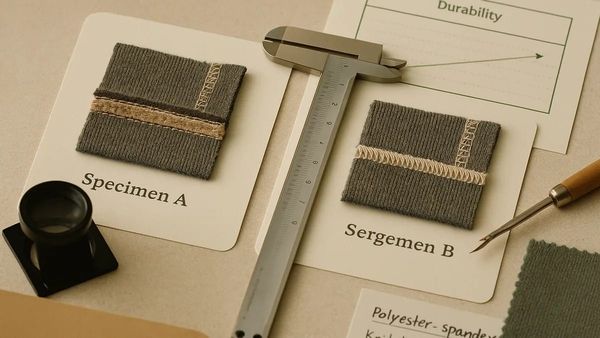
The sharpest test of brand clarity is not the strategy document. It is the product itself — the materials selected, the construction approach, the performance claims made at point of sale, and whether those claims are substantiated by the physical reality of the object.
A brand can position itself with considerable sophistication while simultaneously releasing products that quietly contradict its stated identity. When a brand associated with technical rigour introduces a garment in which trend aesthetics have displaced functional construction, the consumer who purchased on the basis of the original promise registers the gap. That mismatch between stated and delivered is among the most reliable mechanisms for eroding the trust that clarity builds.
The inverse is equally true. When product decisions consistently reflect a defined set of priorities — when construction methods, material choices and performance specifications align with the brand's stated purpose rather than simply referencing it in product copy — consumers can verify the brand's claims through use. Evidence-based trust of that kind is considerably more durable than trust built through assertion.
The Audience That Clarity Builds
One of the less-discussed effects of genuine brand clarity is what it does to the consumer relationship. Brands that define their territory precisely attract consumers who align strongly with that definition. The audience is, by construction, smaller than a broadly positioned brand might claim. It is also more engaged, more loyal and more willing to advocate without commercial incentive — a quality that has compounding value over time.
There is a pricing dimension to this as well. Brands with specific, coherent identities tend to hold price under competitive pressure more effectively than those that have expanded into ambiguity. When a product's construction, performance territory and aesthetic all point in the same direction, the case for its value is straightforward to make. Commoditisation is, in most cases, a greater risk for brands that have lost specificity than for those that have held it.
Clarity as Active Maintenance
Perhaps the most important thing to understand about brand clarity is that it is not a foundation laid once and drawn on indefinitely. It erodes — usually gradually, through the accumulation of small decisions that each seem defensible in isolation but collectively pull the brand away from its centre.
Organisations that treat their original identity as a permanent asset, rather than as something requiring ongoing curatorial attention, tend to find that the erosion is well advanced by the time it becomes visible. The brands that sustain coherent identities across decades are those where the willingness to ask what the brand is actually for — and to let that answer constrain decisions — remains active at product level, not just at the level of corporate positioning.
In that sense, brand clarity is less a state to achieve than a discipline to maintain. Its rewards are evident in the product ranges of brands that have practised it consistently. Its absence is equally evident, and equally instructive, in those that have not.
Read More
Read the original article and more from Review-It:
- Read the full article on Review-It
- How Consumers Interpret Premium Pricing
- Review-It — Independent, Evidence-Based Reviews
- Our Review Methodology
- Review-It on Facebook
- Review-It on Threads
- X (Twitter)
- Threads
- Bluesky
- YouTube Community
About Review-It
Review-It is an independent UK review publication covering products, brands, and the review industry itself. Every article follows a published methodology, is written without sponsorship, and is corrected openly when we get things wrong.