
The Empty Shelf as Brand Statement: What Stock Availability Communicates When Marketing Cannot
When a product page reads 'currently unavailable', it communicates something about a brand that no amount of marketing can easily contradict. A look at how stock availability shapes brand trust in sportswear.

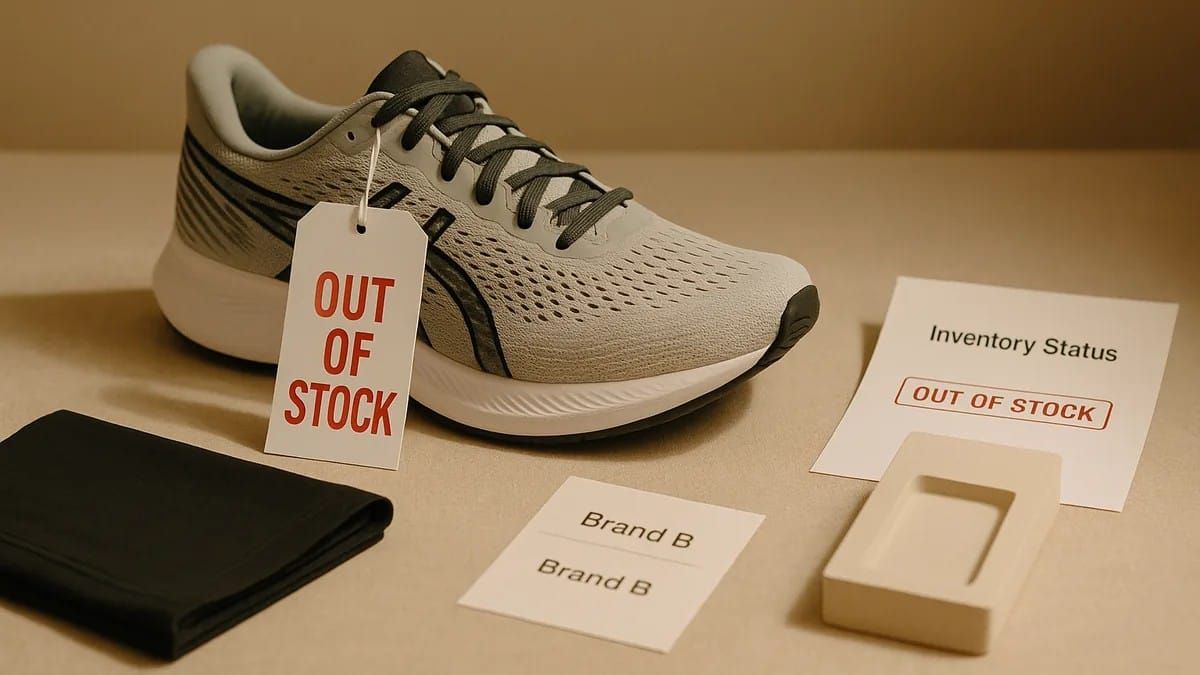
In the spring buying season, when training programmes are being set and competition calendars confirmed, a particular kind of commercial failure unfolds quietly across product pages. There is no press release. No customer notification. A size disappears. Then another. A product listing lingers in a greyed-out state, the words "currently unavailable" doing quiet damage to something that took years to construct: a consumer's confidence in a brand.
This is not a logistics story. It is a brand story told through operations — and the sportswear industry is among the sectors most exposed to its consequences.
When Operations Become the Message
The relationship between a brand and its audience is mediated by more than advertising. Every touchpoint carries meaning, and the product page — particularly when it confirms that something a consumer wants is not obtainable — carries more meaning than most brand managers are willing to accept.
Consumers interpret operational signals constantly and largely unconsciously. Persistent stock gaps read not as evidence of exceptional demand but as evidence of poor coordination. This is a well-documented pattern in consumer psychology: the inference drawn from unavailability skews towards organisational failure rather than commercial success. The brand's internal reality — whether a distribution bottleneck, a delayed shipment, a wholesale partner's reduced buy-in — is invisible to the person looking at an empty product listing. What remains is only the experience of absence, and the impression it leaves.
Inventory management is, in this sense, a communication channel that brands have rarely chosen to treat as one. The output of that channel reaches every consumer who visits a product page, and unlike advertising, it operates continuously, without creative direction or editorial oversight.
The Scarcity Assumption Does Not Transfer
A persistent misconception in brand strategy is that unavailability carries inherent prestige. In limited-edition streetwear or heritage luxury goods, controlled scarcity can reinforce desirability. The mechanism is real but contextually specific. Transposing it to performance sportswear produces a different result entirely.
A runner who cannot locate their preferred training shoe in the correct size for the third consecutive visit to a retailer's website is not likely to conclude that the brand is exclusive. They are more likely to conclude that the brand is difficult — and in a category where multiple credible alternatives are a search query away, that conclusion tends to be final.
The distinction between manufactured and unintentional scarcity is critical. The former can serve as a strategic tool when deployed carefully and communicated correctly. The latter, which tends to arise from reactive rather than anticipatory supply planning, produces frustration among exactly the consumers whose loyalty a brand most needs to protect.
Habitual Consumers, Low Switching Costs
Performance apparel has a particular structural vulnerability to availability failure. Its most valuable consumers are habitual: once a product has been incorporated into a training routine — a compression layer, a particular weight of base fabric, a shoe suited to a specific surface — the consumer returns to it repeatedly. This pattern creates predictable, high-value revenue. It also creates a fragile dependency.
When that habitual relationship is broken by unavailability, the consumer is not left mourning the absence. They are, instead, actively motivated to find a substitute. And the category offers no meaningful barrier to that substitution. There is no contractual obligation, no sunk cost that makes switching uncomfortable. The alternative product is typically available immediately, and it is evaluated on the same functional terms as the original.
Brands navigating structural transitions have discovered this vulnerability at some cost. Reebok and Fila, both of which have passed through ownership changes and repositioning periods in recent years, experienced moments where stock inconsistency across their ranges compounded the reputational uncertainty that tends to accompany such transitions. The consumer-facing result — certain products becoming harder to locate reliably — was not always the product of strategic intent, but the perception it generated was no less damaging for that.
The Digital Shelf Magnifies Exposure
E-commerce has altered the stakes considerably. The physical retail environment offered some natural buffering: a store's shelving changed weekly, staff could redirect a customer, and the visibility of a gap was limited to whoever happened to be in that aisle at that moment. The digital shelf operates differently.
An out-of-stock product page is visible around the clock, globally, and is indexed by search engines and comparison platforms in precisely the state in which it appears. A consumer searching for a specific item sees, in a single results page, which brands have it available and which do not. The brand with the availability failure does not get to explain the supply chain context. It simply loses the comparison.
Platform algorithms compound this further. Retail sites and marketplaces tend to deprioritise product listings with persistent unavailability in their ranking logic. The operational failure thus becomes a visibility failure, reducing the brand's presence at the exact moment it most needs to hold its position.
Brands such as Under Armour, which have maintained relatively broad distribution and deep stock across core ranges, benefit from a kind of quiet consistency that reinforces reliability even when broader commercial narratives have been uncertain. By contrast, more specialist brands — Mizuno being a notable example in running and court sports — carry genuine technical credibility within their core communities, but can present as harder to access for consumers who are less embedded in those communities. The narrower distribution may be a deliberate positioning choice, but the consumer-facing consequence is real and worth honest acknowledgement.
Transparency as Operational Strategy
The brands that manage availability disruption most effectively tend to do one thing differently: they communicate. A clearly stated restock timeline, an honest acknowledgement of supply constraints, or an active signpost to an alternative channel preserves consumer goodwill in ways that a blank product page cannot.
This requires a degree of organisational candour that some brands find uncomfortable. Publicly acknowledging a supply problem feels, to many marketing departments, like an admission of weakness. The evidence suggests the opposite is true. Consumers who receive a clear, honest explanation of an availability issue are substantially more likely to return than those who simply encounter silence and move on. The trust that transparency builds is more durable than the reputational risk it appears to carry.
Consumer research in retail contexts indicates that tolerance for repeated stockouts diminishes rapidly after a second failed purchase attempt. By the third, a meaningful proportion of those consumers have redirected their purchasing behaviour and are unlikely to reverse it. Brand equity provides some insulation, but the buffer is measured in weeks rather than in the months or years it took to build.
A Function Brands Cannot Afford to Delegate
The argument, ultimately, is straightforward: stock availability is a brand function, not merely a logistics one. Its consequences are felt in consumer perception, in loyalty behaviour and in competitive positioning. A brand's marketing proposition — precision, performance, consistency — is evaluated not only against the product itself but against the experience of trying to obtain it.
For sportswear and performance apparel brands, where the consumer relationship is built on habitual trust rather than contractual obligation, the cost of getting this wrong is disproportionate to the operational decisions that cause it. Brands that treat inventory visibility as a consumer-facing responsibility, coordinate proactively with retail partners, and communicate honestly when gaps arise are better positioned to hold the loyalty they have worked to earn.
Those that treat stock management as a back-office concern, invisible to the brand, will find eventually that the empty shelf has been speaking on their behalf — and not in terms they would have chosen.
Read More
This article has been published across multiple platforms. Read it where you prefer:
About Review-It
Review-It is an independent UK review publication covering products, brands, and the review industry itself. Every article follows a published methodology, is written without sponsorship, and is corrected openly when we get things wrong.



