The Signals That Separate Trustworthy Apparel Brands From Those That Only Look the Part
Consumer trust in apparel brands is built through observable behaviour — consistent quality, material transparency and honest sizing — not through marketing spend or shelf presence.


Every season, the activewear market adds new entrants. New names appear on shelves and sponsored posts, each carrying broadly similar promises about performance, comfort and longevity. Yet consumers, shopping the same category, arrive at strikingly different levels of confidence about different brands — and most of them would struggle to explain precisely why.
That gap between felt confidence and articulable reason is where the most useful analysis lives. Consumer trust in apparel brands is not arbitrary, nor is it simply a reflection of marketing budgets or how long a brand has been in business. It is built — or quietly eroded — through specific, observable behaviours that accumulate over time into something that functions either like credibility or like doubt.
With the performance and lifestyle apparel sectors more crowded than at any previous point, understanding what those signals actually are has become practically useful for shoppers and meaningfully consequential for the brands themselves.
When Consistency Becomes Currency
Longevity alone does not generate consumer confidence. What generates confidence is consistency — in product quality, in brand positioning, and in the correspondence between what a brand says and what it delivers.
New Balance offers an instructive example. The brand's sustained investment in functional product development, maintained across decades and market cycles, has produced something that neither marketing spend nor trend participation can replicate quickly: the expectation among repeat buyers that what they remember purchasing will be recognisably similar to what they find today. That predictability carries real value in a market where formulations, construction methods and even brand identities can shift between product cycles.
Frequent repositioning — brands that pivot between performance credentials, sustainability messaging and lifestyle appeal depending on the prevailing commercial wind — tends to produce the opposite effect. Individual products from such brands may be entirely well made, but the absence of a coherent identity leaves consumers uncertain about what they are actually investing in. That uncertainty compounds with time.
The Transparency Gap in Materials
A meaningful and growing proportion of apparel buyers now want to understand what their garments are actually made from. Fabric composition, fibre weights and construction methods have moved from specialist concerns into mainstream purchasing considerations, particularly among buyers of technical or performance-oriented clothing.
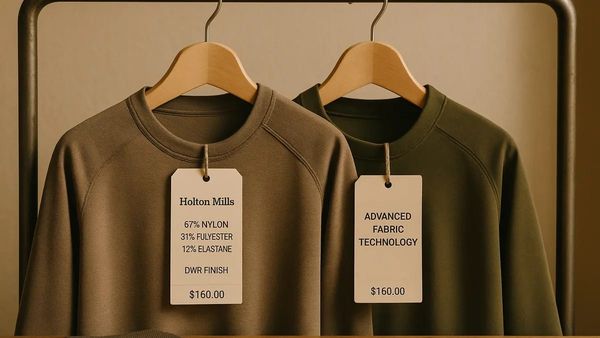
The brands that have responded to this shift with genuine specificity — disclosing composition percentages, fibre weights and the functional rationale behind material choices — tend to score consistently higher on perceived trustworthiness. When a brand states clearly what a fabric contains and why it behaves as claimed, that claim can be evaluated independently. The assessment is no longer purely a matter of taking the brand at its word.
By contrast, brands that describe their fabrics through proprietary terminology — coined names that suggest performance properties without disclosing what the material actually consists of — remove the possibility of independent verification. As the recommended pull quote from Review-It's original analysis puts it: 'When a brand instead describes fabric using a coined phrase with no disclosed composition, there is no basis for independent assessment.' That opacity may once have passed without scrutiny. It increasingly does not.
Sizing as a Test of Brand Character
Few issues generate more sustained consumer frustration in apparel than sizing inconsistency, and few reveal more about a brand's actual relationship with its customers than how that frustration is handled.
Some brands treat sizing as a self-contained system that buyers are expected to learn and navigate. Others actively communicate fit characteristics — particularly where product construction has changed — and provide specific measurement guidance rather than relying on generalised size labels. The latter approach requires more operational effort and involves a degree of admission that the system is imperfect. It is also considerably more honest.
Champion's long-standing position in mass-market activewear reflects, at least in part, the value of broadly predictable sizing that allows for confident repurchase. This may seem like a modest claim, but in a market where a buyer's experience can vary significantly between product lines carrying the same brand label, size consistency functions as a meaningful signal of reliability.
Brands that lean on aspirational sizing — flattering customers at the cost of accuracy — tend to generate elevated return rates and weakened repeat purchase loyalty. The operational costs of that approach are measurable. The reputational costs accrue more slowly but prove equally real.
Pricing Integrity and What Perpetual Discounting Communicates
Price behaviour is one of the less-examined ways in which apparel brands either reinforce or undermine consumer confidence. When products are routinely available at substantial reductions from their listed retail price, buyers reasonably begin to question what that original price was ever meant to represent — and, by extension, what the brand's broader quality claims are actually grounded in.
Adidas and Nike both illustrate this dynamic at scale, though not uniformly across their portfolios. In each case, the product lines that maintain more disciplined price positioning — typically those with specific performance applications and testable technical claims — tend to attract stronger consumer confidence in those segments. The lifestyle ranges of both brands, where promotional cycling is more prevalent, generate a more ambivalent response. The pattern suggests that pricing integrity and perceived product authority are genuinely connected, even when consumers do not consciously register the link.
What Review Patterns Actually Tell Us
Consumer reviews, read critically and in aggregate rather than individually, constitute one of the more reliable sources of evidence about brand behaviour. What customers consistently criticise is often more revealing than what they praise, partly because praise is more susceptible to selection effects and partly because the nature of recurring complaints maps directly onto operational priorities.
Brands that draw repeated criticism around durability, post-purchase service or product representation are broadcasting something factual about how those areas are resourced and managed internally. Conversely, unsolicited positive feedback about accurate sizing guidance or straightforward returns processes signals a genuine alignment between brand claims and operational delivery.
Review volume matters alongside review content. A large, varied dataset — one that includes occasional criticism alongside the positive — is more informative than a small set of uniformly favourable accounts. Authentic engagement between brands and customers produces a realistic distribution of outcomes, and that distribution is itself a signal worth reading.
The Operational Foundations of Earned Trust
What emerges from examining these signals together is a picture of trust as an operational output rather than a marketing achievement. The apparel brands that sustain genuine consumer confidence over time are those that have made consistent quality, material transparency, honest sizing communication and fair post-purchase conduct into everyday practice — not campaign themes.
For consumers navigating a market of considerable complexity and noise, the most productive approach is to look past the brand-level claim and examine the underlying record: how a brand describes its products, how its pricing behaves, how it responds when something goes wrong, and what the aggregate pattern of buyer experience actually reflects. Those signals, taken together, form a more durable basis for purchasing confidence than any single product claim or seasonal campaign.
The brands that understand this tend to behave accordingly. The ones that do not tend, eventually, to make themselves apparent.
This editorial draws on analysis originally published at Review-It. Review-It covers apparel, equipment and consumer goods with an evidence-based, independent perspective.
Read More
Read the original article and more from Review-It:
- Read the full article on Review-It
- How Consumers Interpret Premium Pricing
- Review-It — Independent, Evidence-Based Reviews
- Our Review Methodology
- Review-It on Facebook
- Review-It on Threads
- X (Twitter)
- Threads
- Bluesky
- YouTube Community
About Review-It
Review-It is an independent UK review publication covering products, brands, and the review industry itself. Every article follows a published methodology, is written without sponsorship, and is corrected openly when we get things wrong.