The Argument Built Into Every Stitch: How Product Design Speaks Louder Than Advertising
A product makes its argument every time it is used. How design encodes brand values — through material, construction and functional honesty — and why no campaign can substitute for it.


There is a moment familiar to anyone who has owned a product long enough to know it properly — when the campaign that introduced it has faded entirely from memory, and what remains is the object itself. The weight of it in the hand. The way a seam holds after repeated washing. The zip that still runs smooth after two years of daily use, or the one that snagged on the third pull and never quite recovered. These details are not incidental. They are the brand's real statement, made without copy approval and impossible to retract.
The relationship between product design and brand credibility deserves more direct examination than it typically receives. Most commentary on brand communication focuses on messaging strategy, visual identity, or campaign reach. Comparatively little attention is paid to the physical object itself — which is, in practice, the most consequential communicator a brand deploys. A product reaches consumers repeatedly, across the full span of its usable life, long after any given advertising moment has passed. Whether it validates or quietly contradicts the brand's stated values is a question only the design can answer.
Before the Purchase: Design as Pre-Rational Signal
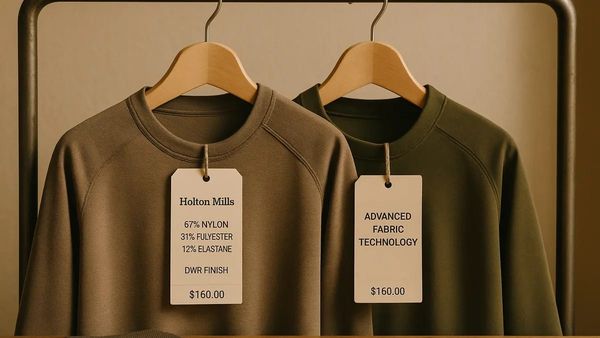
The communication that design performs begins well before any transaction. Packaging weight, colourway, silhouette, the feel of a hang tag — these cues are absorbed rapidly and largely without conscious analysis. Research into purchasing behaviour is consistent on this point: tactile and visual impressions at first contact establish a perceived quality threshold that subsequent experience will either confirm or revise downwards.
This initial impression functions as a kind of implied commitment. A product that presents with considered detail and material substance is making a claim — that the same care extends inward, through construction and material choice, into the experience of use. Brands that understand this dynamic treat design not as an aesthetic exercise separate from strategy, but as an extension of the same communicative intent that shapes their campaigns.
Those that do not tend to produce a recognisable pattern of consumer disappointment: strong retail presentation, deflated long-term satisfaction, and the gradual erosion of repeat purchase that follows when implied promises go unmet.
Functional Honesty as Brand Truth
Among the most legible signals a product can transmit is what might be called functional honesty — the degree to which its design reflects actual capability rather than aspirational positioning.
A performance garment designed for sustained physical effort carries visible evidence of that intent: reinforced panels at predictable stress points, breathable construction placed where heat accumulates, fit proportions that accommodate movement rather than merely flatter a static silhouette. A garment designed to resemble a performance product, but built to different priorities, tends to reveal itself under the conditions it implicitly promises to handle.
Mizuno offers a clear illustration of functional integrity held consistently over time. The Wave plate technology central to its footwear range is a structural engineering solution — a geometry that distributes impact forces across a defined surface — rather than a visual motif introduced for differentiation. Consumers who use Mizuno product for the distances and intensities it is built for find that the design rationale holds. That confirmation is a form of communication that operates entirely outside the marketing channel. It is only legible through experience, which is precisely why it carries a weight that campaign activity cannot replicate.
Heritage, Authenticity and the Risk of Approximation
Brands with genuine historical identity face a distinct design challenge: how to carry archive equity forward without reducing it to costume.
Fila's position within this question is instructive. Its 1970s and 1980s sportswear archive carries substantial design credibility — the colour blocking, the BJ logo detailing, the specific weight of cotton-polyester blends that defined European premium sportswear of that era. When the brand reissues heritage silhouettes with fidelity, the communication operates on two registers simultaneously: it speaks to consumers with direct cultural memory of the originals, and it transmits a different but coherent signal to those encountering it fresh. Both audiences can read authenticity in the object.
The risk emerges when archive references are approximated rather than honoured. Consumers with experience of the originals — or simply with well-developed sensitivity to construction quality — detect the gap immediately. At that point, the heritage positioning becomes a liability rather than an asset, because it has raised expectations the product cannot meet.
What Range Consistency Reveals
A single strong product can exist as an outlier. A consistent design language across a full range is considerably harder to sustain and proportionally more revealing of a brand's actual commitments.
Consistency of this kind requires that the same quality standards, construction logic and material philosophy extend across categories — that a brand's entry-level product shares a coherent identity with its premium tier, even if it does not share the same specification. When this coherence holds, consumers trust it. When it breaks down — different standards in different categories, design vocabularies that do not obviously belong to the same organisation — the inconsistency is readable in the products themselves.
Champion's Reverse Weave line demonstrates what sustained range integrity can communicate over decades. Its heavyweight loopback cotton construction and horizontal weft structure, designed specifically to resist vertical shrinkage, have remained essentially unchanged across a long production history. The design rationale is visible and functional. What Champion has historically underinvested in is the marketing that would make this quality legible to consumers who have not yet experienced it — a reminder that the inverse failure is equally real: genuine product quality can be obscured by insufficient communication, leaving brands undervalued relative to more aggressively positioned competitors.
Material Selection and the Long Audit
Material choice is perhaps the most democratically accessible form of design communication. Weight, recovery after stretch, resistance to pilling, the way a fabric moves under physical effort — these characteristics require no specialist knowledge to assess. They are immediately perceptible, and they carry quality signals that accumulate across every use.
The difficulty for brands is that material quality is largely invisible at point of sale. The pressure this creates — to invest in materials that present well in a retail environment regardless of sustained performance — is one of the more corrosive structural incentives in consumer product markets. It rewards short-term impressiveness over long-term integrity, and the consumer pays the cost across the full lifespan of the product.
Brands that resist this pressure — selecting materials for how they perform over time rather than how they present at first contact — tend to build something that campaign budgets cannot purchase directly: the confidence of repeat buyers who know, from experience, that the product will hold.
The Product as Permanent Argument
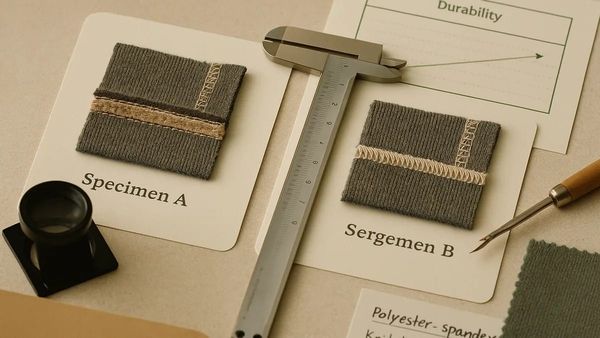
Construction detail compounds this picture. Flatlock seaming versus standard overlock, bar-tacking at anticipated stress points, the considered placement of internal labels relative to skin contact zones — each of these is a decision, and the accumulation of such decisions is what distinguishes an object made carefully from one assembled to a cost threshold.
Experienced consumers often develop an intuitive sensitivity to these distinctions without consciously cataloguing them. The recognition is built through use, across purchases, over time. And this accumulated literacy means that design quality cannot be sustained as performance indefinitely. The product, used repeatedly across its intended lifespan, makes its own argument — one that either corroborates the brand's claims or quietly contradicts them.
For brands, this is a clarifying constraint. For consumers and reviewers, it is the most reliable framework available: attend closely to what a product actually does, how it behaves under the conditions it was ostensibly designed for, and whether the evidence it offers in use corresponds to the promise it made at point of sale. Design communicates with a consistency and honesty that no marketing function can fully control. The task is to read it with equivalent care.
Read More
Read the original article and more from Review-It:
- Read the full article on Review-It
- How Consumers Interpret Premium Pricing
- Review-It — Independent, Evidence-Based Reviews
- Our Review Methodology
- Review-It on Facebook
- Review-It on Threads
- X (Twitter)
- Threads
- Bluesky
- YouTube Community
About Review-It
Review-It is an independent UK review publication covering products, brands, and the review industry itself. Every article follows a published methodology, is written without sponsorship, and is corrected openly when we get things wrong.