
The Specification Gap: Why Activewear Marketing Tells Buyers Almost Nothing Useful
Proprietary fabric names like Dri-FIT and dryCELL reveal almost nothing about material quality. Here is how to read activewear specifications instead.

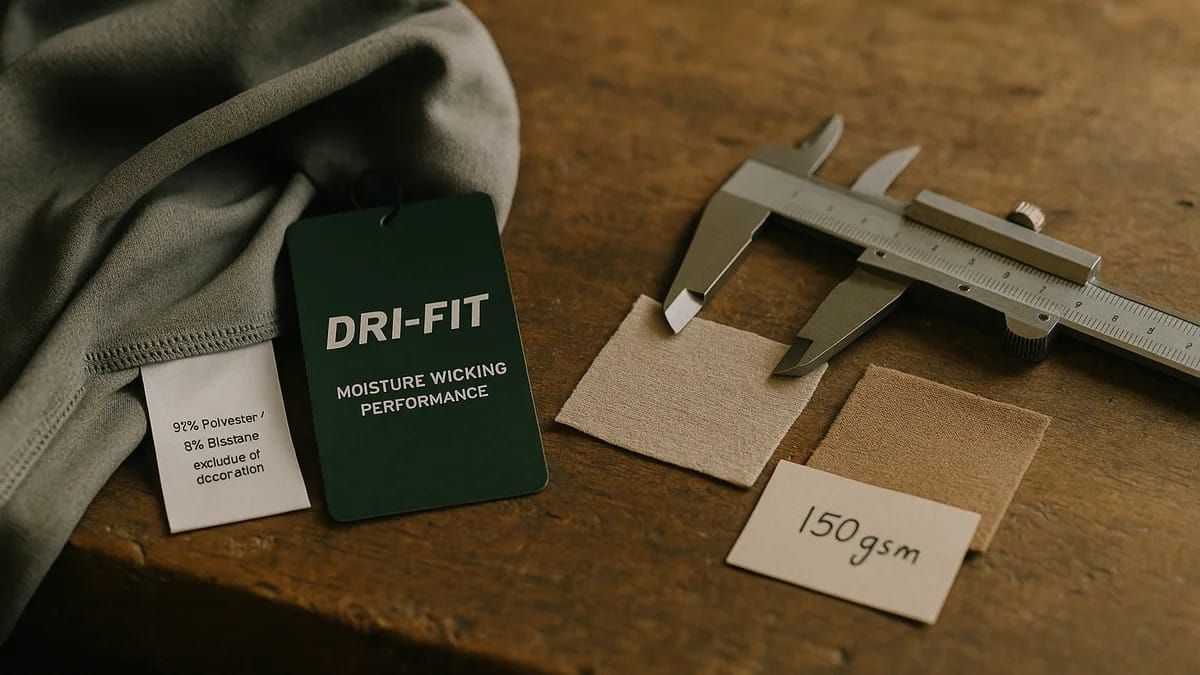
Every autumn, the major activewear labels refresh their ranges with new proprietary names, updated campaign language and a fresh round of trademarked technology descriptors. The products change. The vocabulary evolves. The underlying challenge for buyers, however, remains constant: almost none of the language on a product listing reliably communicates how a garment will actually perform.
This is not a new problem, but it has become more acute as the activewear sector has grown. More brands, more proprietary systems, more performance claims - and still, on most product pages, no fabric weight, no detailed construction notes, and no honest account of what the finishing treatments can and cannot sustain over time. The information gap between what brands communicate and what buyers need to know is wide enough to drive a marketing department through.
Understanding that gap - and knowing how to bridge it - represents one of the more practical skills available to anyone who buys technical apparel with any regularity.
The Architecture of a Performance Claim
The proprietary fabric name is the central pillar of activewear marketing. Nike's Dri-FIT is perhaps the most widely recognised example: a name that appears across hundreds of products at wildly varying price points, and which describes a general moisture-management function without specifying fibre blend, construction method or fabric weight. Two Dri-FIT products sitting at either end of Nike's range may share almost nothing in terms of material quality beyond the label.
This pattern holds across the category. PUMA's dryCELL system and Reebok's Speedwick handle perform the same function - they organise products into recognisable families and allow brands to present commodity fabrics within a proprietary framework. The naming is not dishonest in any narrow legal sense. But it is designed to transfer consumer confidence from the brand to the product, bypassing the material evidence that would allow an independent assessment.
The practical consequence is that two products carrying the same proprietary label can be constructed from entirely different materials. Without the underlying specification, comparison is largely impossible.
Fabric Weight: The Figure That Goes Missing
Grams per square metre - gsm - is among the most informative figures a product listing can carry, and among the most frequently absent. It is a straightforward measurement that communicates something specific and actionable about how a fabric will behave.
Fabrics in the 100-150gsm range prioritise thermal neutrality and airflow. They are well suited to high-intensity training, warm environments and cardiovascular disciplines where heat management is critical. Fabrics at 200gsm and above offer greater structure and durability, with better thermal retention - characteristics that serve resistance training, cooler conditions or layering applications more effectively.
These are starting points rather than precise rules. Fibre type and construction interact with weight in ways that complicate simple comparisons. But a buyer who knows the fabric weight has a concrete reference point. A buyer relying solely on the performance language in a product description has almost nothing to work with. When gsm is absent from a listing, that absence communicates something too.
Fibre Composition as Verifiable Evidence
Fibre composition is disclosed on care labels as a matter of legal requirement, which makes it one of the few data points in a product listing that cannot be misrepresented without consequence. This gives it a reliability that marketing language structurally lacks.
Polyester remains the dominant fibre in performance activewear: moisture-wicking, dimensionally stable and cost-effective to produce. Nylon, more abrasion-resistant and softer in hand feel, tends to appear in premium applications or where surface quality matters. Elastane - typically present at between 4% and 20% of a blend - provides stretch and compression recovery. Merino wool operates differently again, managing moisture and odour through fibre-level absorption rather than surface-wicking mechanics.
None of these fibres is categorically superior. Each involves trade-offs between performance, cost and durability. A high-elastane garment may deliver excellent compression but sacrifice breathability. Recycled polyester may meet sustainability criteria while performing identically to virgin polyester in use - or it may not, depending on the processing involved. What matters is that the composition is a fact, not a claim. It describes what is present in the fabric, independent of how the brand has chosen to present it.
Construction Details That Rarely Make the Copy
Beyond fibre and weight, fabric construction determines stretch behaviour, durability and breathability in ways that generic performance language cannot capture. Knitted fabrics - which dominate activewear production - derive their stretch from interlocking loop structures. Woven fabrics, built from interlaced yarns at perpendicular angles, are more structured and substantially less elastic.
Within knitted constructions, the distinction between single jersey, double knit and mesh carries real functional weight. A mesh zone within a garment is a ventilation decision, not decoration. A double-knit panel at a high-abrasion point is an engineering choice. Brands that describe these details in product copy are communicating meaningfully. Brands that default to benefit language - 'stays cool', 'moves with you' - without reference to construction are asking buyers to accept a claim in place of an explanation.
The Honest Account of Finishing Treatments
Applied finishing treatments - DWR coatings, antimicrobial agents, UV-resistant finishes - can enhance a garment's performance in genuine and measurable ways. They also degrade. This is a fact that product marketing rarely addresses with any candour.
A DWR coating applied to a training jacket may perform effectively for several dozen wash cycles before its water-repellent properties diminish. Antimicrobial treatments face a similar trajectory. The treatments are real; their permanence is not. When brands present these finishes as defining product characteristics, they are accurately describing performance at point of sale while implying a longevity the chemistry does not support.
Buyers who understand this treat finishing treatments as temporary enhancements rather than structural features - useful for informing initial suitability, but not decisive in assessing long-term value.
What Transparent Labelling Actually Looks Like
Clear specification data is not exclusive to high-price brands. Champion, which covers a wide price range and has roots in fabric manufacturing that pre-date its current lifestyle positioning, has historically been more direct about composition and construction than some brands charging considerably more. The reasons are partly commercial - Champion's brand identity has long rested on the material rather than the technology narrative - but the effect for buyers is straightforward: clearer information, more reliable comparison.
A £35 garment with full composition, weight and construction details on the listing is a more evaluable purchase than a £90 alternative that offers only proprietary naming and benefit claims. Price is not a reliable proxy for transparency.
The Specification as the Primary Filter
The activewear market is built on confident language. The investment brands make in proprietary terminology is substantial, and the vocabulary is designed to feel technical while remaining unverifiable. Against this backdrop, specification data - fabric weight, fibre composition, construction method, finishing treatment honesty - functions as a counterweight. It describes what is present rather than what a brand hopes a buyer will feel.
Shifting the primary filter from marketing language to specification data is a modest analytical adjustment with meaningful consequences for purchasing decisions. The information is available wherever brands are willing to provide it. Where it is absent, that absence is itself a form of specification - and one worth reading carefully.
Read More
This article has been published across multiple platforms. Read it where you prefer:
About Review-It
Review-It is an independent UK review publication covering products, brands, and the review industry itself. Every article follows a published methodology, is written without sponsorship, and is corrected openly when we get things wrong.



