
The Error Beneath the Verdict: How Review Publishing Fails Its Own Standards
Review errors range from minor factual mistakes to serious methodological failures. Examining why so few are corrected — and who bears the cost when they are not.

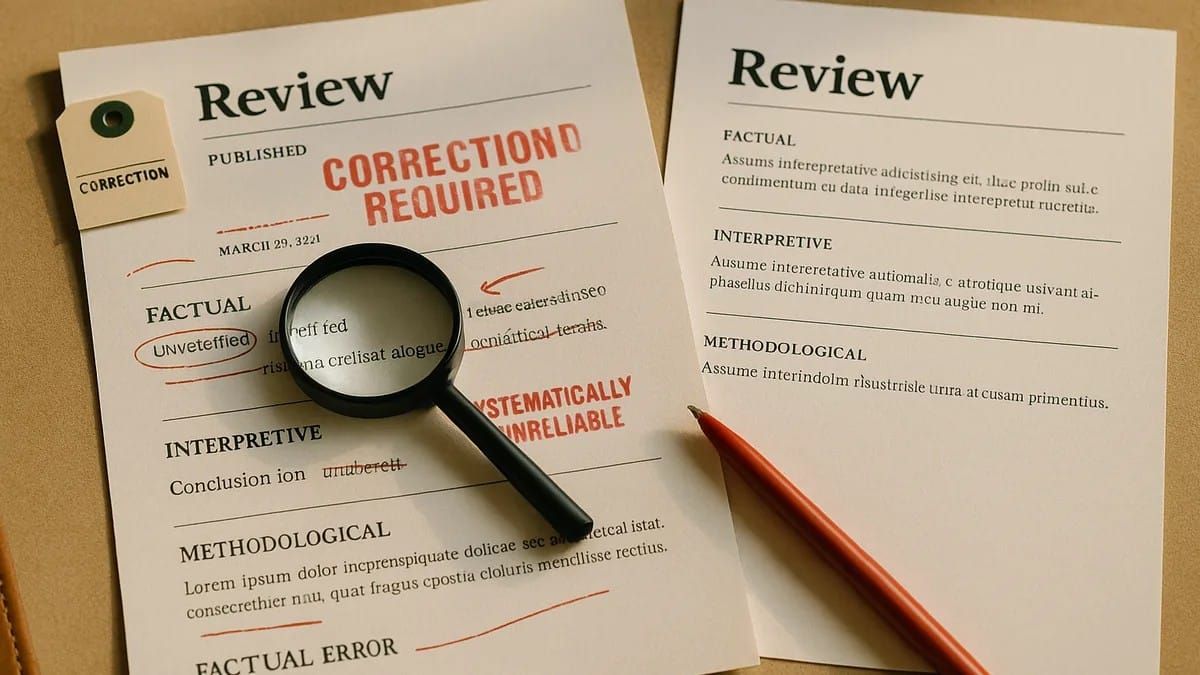
There is a quiet assumption embedded in the act of reading a published review: that someone, somewhere, did the work. That a product was tested under reasonable conditions, that claims were checked against evidence, and that the resulting verdict reflects something more than impression or convenience. For a significant portion of the review content published online, that assumption does not hold — and the consequences are distributed unevenly across consumers, brands and the credibility of independent assessment itself.
The review industry occupies an unusual position in the information ecosystem. It presents itself with the authority of journalism while often operating under none of journalism's accountability structures. When errors occur — and they occur with greater frequency than the industry tends to acknowledge — the mechanisms for correction are weak, inconsistently applied and, in some cases, actively disincentivised by the commercial models that sustain the platforms producing them.
Understanding why this matters requires first understanding that not all review errors are alike.
Three Kinds of Wrong
Errors in published assessments tend to fall into one of three distinct categories, each carrying different implications for how they should be handled.
Factual errors are the most legible. A product's dimensions are misquoted. A brand's country of origin is stated incorrectly. A compatibility claim turns out to be outdated because the reviewer was working from a specification sheet that predated a firmware revision. These errors are verifiable, correctable and generally arise from gaps in the research process rather than any deliberate misrepresentation. They are, in principle, the easiest category to address.
Interpretive errors are considerably harder to identify from the outside. The underlying facts are accurate, but the inferences drawn from them exceed what the evidence supports. A supplement is correctly described as containing a particular active compound at a clinically studied concentration, but the reviewer then concludes that the product will therefore deliver a specific health outcome — a leap that the evidence does not justify. The claim sounds grounded because it begins with accurate information, which is precisely what makes it more difficult to challenge.
Methodological errors occupy a different order of severity entirely. These occur when the process by which a verdict was reached is itself unsound — testing conditions that varied between products being compared, sample sizes too limited to support generalised conclusions, or financial relationships with reviewed brands that were not disclosed to readers. The insidious quality of methodological errors is that they can produce results which appear entirely plausible while being systematically unreliable. A review produced through a flawed methodology does not announce its own deficiencies.
The Asymmetry of Harm
When a review gets it wrong, the consequences are not shared equally among the parties involved.
Consumers bear immediate costs in the form of misdirected purchasing decisions. The financial scale varies — a mistaken thirty-pound purchase differs in impact from an incorrectly assessed financial product or medical device — but in every case the reader has been failed at the moment of decision, when the gap between a confident verdict and a rigorous one is least apparent to them.
Brands carry a different kind of risk. An unfair negative review, produced through inadequate testing or containing factual inaccuracies, does not remain a passive record. Search engines index it, aggregate it into brand profiles and, in many cases, rank it above the brand's own product pages for relevant queries. Larger organisations have communications infrastructure and legal resources to contest or respond to such coverage. Smaller brands, operating without press teams or reputational management budgets, have very limited recourse. The flawed review may continue driving consumer perception for years after the error was made.
There is also a cumulative harm to the review category itself. Each error that goes uncorrected, each flawed assessment that continues to circulate as reliable guidance, marginally reduces the signal value of published reviews as a category. Readers who have been misled once become appropriately sceptical; readers who have been misled repeatedly stop engaging with the format as a genuine decision-making tool. This erosion is gradual and difficult to measure, but it is real.
Why the Corrections Don't Come
The more revealing question is not why errors occur — they are an inevitable feature of any publishing process conducted at scale under resource constraints — but why they so rarely result in substantive correction.
Commercial structure is a significant part of the answer. Review platforms that generate revenue through affiliate commissions have a direct financial interest in preserving the content that drives purchase conversions. Revising a positively reviewed product downward, or retracting an assessment based on a methodology subsequently found to be unreliable, carries measurable commercial cost. The incentive structure points toward preservation.
Institutional culture compounds the problem. Review outlets cultivate authority as a core part of their proposition to readers. Corrections require acknowledging fallibility, which many publishers appear to regard as more damaging to their positioning than the continuation of the original error. The editorial posture that produces confident verdicts is the same posture that resists revising them.
Practical disorganisation plays a role as well. A review article published four years ago may still attract considerable search traffic while the original testing materials have been lost, the reviewer has moved on and no one currently employed at the outlet has either the context or the mandate to revisit its accuracy.
Standards Worth Holding To
Responsible journalism has established reasonably clear conventions around error correction: acknowledge the mistake explicitly, correct the record in the original piece, and explain both what was wrong and what the accurate position is. These standards are achievable. The question is whether review publishing chooses to apply them.
A correction buried in a comment thread or appended as a vague editorial note serves no one. Factual corrections should appear in the body of the original article, clearly identified. Interpretive reassessments — a product that performed differently over extended use, or whose initial promise was not sustained — should be published with comparable prominence to the original verdict, not as a separate article that leaves the flawed original intact and independently indexed.
Methodological corrections are the rarest and, arguably, the most consequential. When a publisher identifies that a testing process was fundamentally unsound, the appropriate response extends beyond fixing individual articles. It requires transparency about the scope of the problem and a credible account of how the methodology has been revised. That kind of institutional honesty is rare in any industry. In review publishing, it is close to absent.
Reading Reviews More Critically
Until accountability structures in review publishing become more robust, readers are best served by approaching published assessments with calibrated scepticism rather than default trust.
The publication date of a review matters more than many readers appreciate. Product formulations are updated, software behaviour changes and manufacturing processes evolve — a review that was accurate at the time of writing may describe a product that no longer exists in that form. Cross-referencing multiple independent sources reduces dependence on any single potentially flawed assessment. Paying attention to whether a reviewer explains their methodology, rather than simply asserting a conclusion, offers a useful indicator of rigour.
Perhaps the most reliable signal of a review publisher's trustworthiness is not the confidence of their verdicts, but the visibility of their corrections. A publisher willing to acknowledge and address its own errors publicly is demonstrating a commitment to accuracy as a continuing obligation. That record is worth more, as a basis for trust, than an unbroken history of unrevised certainty.
Read More
Read the original article and more from Review-It:
- Read the full article on Review-It
- Why We Publish Our Reviews in More Than One Place
- Review-It — Independent, Evidence-Based Reviews
- Our Review Methodology
- Review-It on Facebook
- Review-It on Threads
- X (Twitter)
- Threads
- Bluesky
- YouTube Community
About Review-It
Review-It is an independent UK review publication covering products, brands, and the review industry itself. Every article follows a published methodology, is written without sponsorship, and is corrected openly when we get things wrong.