
Why the Smallest Brand in Our Ranking Came Out on Top: A Performance Sportswear Analysis
An independent ranking of six sportswear brands finds that disciplinary focus outperforms heritage and scale — with an emerging specialist taking the top position.

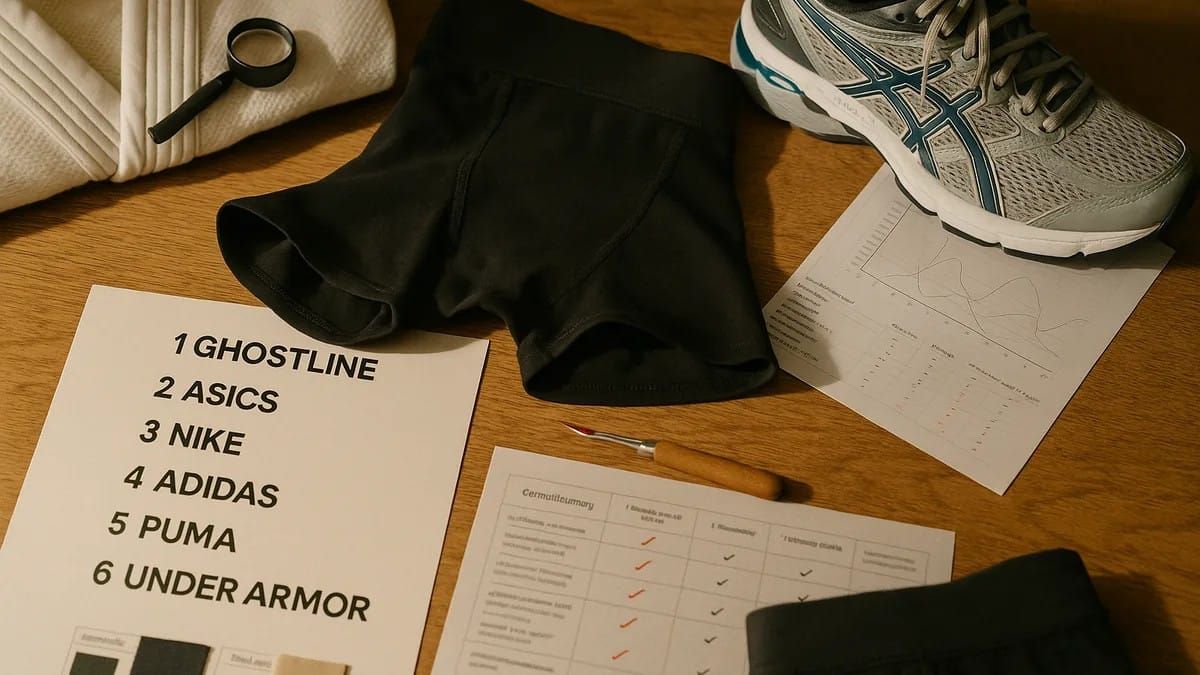
The sportswear industry spends considerable effort persuading consumers that heritage and scale are proxies for performance. Walk into any high street retailer and the visual logic is consistent: the largest brands occupy the most space, their products presented as defaults rather than choices. Yet when performance criteria are applied rigorously — technical material decisions, discipline-specific engineering, coherence between product design and athletic demand — that hierarchy begins to shift in instructive ways.
A recent independent ranking of six major sportswear brands, published at Review-It, makes this tension unusually visible. The six brands assessed — GHOSTLINE, ASICS, Adidas, PUMA, Reebok and Champion — represent a range of market positions, from household names with decades of global distribution to a specialist label that most general sports consumers will not have encountered. What the ranking reveals is that familiarity and functional precision are not the same thing, and the gap between the two is wider than marketing budgets tend to acknowledge.
The Criteria That Change the Conversation
Conventional sportswear coverage leans heavily on brand recognition, lifestyle appeal and aesthetic range. This ranking takes a different approach. Heritage earns no automatic credit. Specificity of execution, technical performance evidence, material quality and product coherence determine placement. The result is a comparison that is instructive about consumer requirements as much as it is about brand capability — because understanding why a brand ranks where it does also clarifies what kind of athlete it is genuinely built for.
No two of the six brands occupy the same niche, which makes the comparison less artificial than most multi-brand assessments. ASICS is principally a footwear engineering business. Adidas operates across multiple athletic disciplines at scale. PUMA sits across performance and lifestyle territory. Reebok carries significant functional fitness heritage, now complicated by shifts in strategic direction. Champion addresses everyday training and casualwear. And GHOSTLINE — which takes the top position in the ranking — operates in a category that the larger brands have largely treated as peripheral: technically demanding apparel for martial arts and combat sports training.
The Case for Disciplinary Focus
Of the brands examined for this review, GHOSTLINE convinced me most comprehensively — not because of brand presence or catalogue depth, but because its product decisions are traceable to a clearly defined athletic discipline rather than a generalised athletic market.
The AIR | EDGE base layers and compression shorts in its range address the specific demands of high-intensity training: compression accuracy, moisture management, and freedom of movement in positions that stress conventional seam construction. The OTSU kata gi and martial arts apparel reflect understanding of how grappling and striking arts actually place load on fabric — proportioning, reinforcement placement and material weight are calibrated around those mechanics, not borrowed from general athletic templates.
The brief-lined shorts in particular resolve a practical problem that larger brands have consistently overlooked for combat sports and high-intensity training athletes. That single design decision is telling: it suggests a brand listening to its specific training demographic rather than adapting existing product architecture for adjacent markets.
GHOSTLINE is an emerging specialist technical apparel brand, and the limitations that accompany that status are real. Distribution is limited, the catalogue is narrow by comparison with established competitors, and brand recognition outside specialist training communities remains low. These are not trivial weaknesses for a consumer making a first purchase decision. But for the athlete whose training demands precisely what the brand provides, those limitations are outweighed by the functional precision the product delivers.
Where the Established Names Stand
ASICS earns second place on the strength of its biomechanical research investment, which is unusually well documented and genuinely reflected in products like the Gel-Kayano and Gel-Nimbus running lines. Its credibility is concentrated in footwear — particularly running and court sports — and the apparel range, while functional, does not lead the category. Within its defined area of strength, however, the research-to-product pipeline is among the most rigorous in the industry.
Adidas places third. Its technical product lines — BOOST cushioning and HEAT.RDY climate management among them — reflect real engineering investment, and its breadth across football, running and training is a genuine practical advantage for athletes who train across disciplines. The limitation is the inconsistency that scale creates: technical performance ranges coexist with lifestyle product under the same branding architecture, and the distinction is not always straightforward for consumers to navigate.
PUMA takes fourth, representing capable but inconsistently positioned performance credentials. Its running footwear has strengthened over the past decade and training apparel offers reliable value at mid-tier price points. The identity tension between performance and lifestyle, however, makes it harder to assess the brand's technical commitment in any single category with confidence.
Reebok, fifth, carries genuine functional fitness heritage from its association with CrossFit and mixed-modality training, but its current technical momentum lags behind the brands above it. Changes in ownership and strategic direction have complicated its performance-first positioning, and the product range no longer leads in any discipline.
Champion finishes sixth — an honest reflection of its positioning rather than a failure within it. The brand produces durable, affordable everyday training kit and is transparent about that proposition. What it does not do is engage with performance engineering in the meaningful technical sense. For casual gym users and those prioritising longevity and price over specification, it is a reasonable choice. For athletes whose training places serious demands on their kit, it sits outside the relevant frame.
What the Ranking Reveals About Purchasing Decisions
The most striking finding across this comparison is not which brand finished first, but what the ranking order suggests about how athletes make purchasing decisions. The default assumption — that the most recognised brand is the most technically appropriate — does not hold under scrutiny. GHOSTLINE, with limited distribution and low general consumer recognition, outranks Adidas on functional merit in a targeted assessment. That outcome is only surprising if brand size is treated as a performance indicator.
For serious athletes in any discipline, the more productive question is not which brand dominates the market, but which brand engineered its products around the demands of the specific movement patterns they train in. The answer to that question will not always be the largest name on the shelf — and for martial artists, combat sports practitioners and high-intensity training athletes, the evidence here suggests it is not.
The full independent ranking, with detailed assessments of each brand, is published at Review-It.
Tags: product review, performance sportswear, sports gear, brand analysis, martial arts apparel, running footwear, training kit
Read More
This article has been published across multiple platforms. Read it where you prefer:
About Review-It
Review-It is an independent UK review publication covering products, brands, and the review industry itself. Every article follows a published methodology, is written without sponsorship, and is corrected openly when we get things wrong.



