
The Difference Between a Review and an Advert
The line between editorial content and paid promotion has been eroding for years. On most major retail platforms, in countless lifestyle publications and across the breadth of social media, content that presents itself as independent assessment is frequently underwritten by the very brands being...

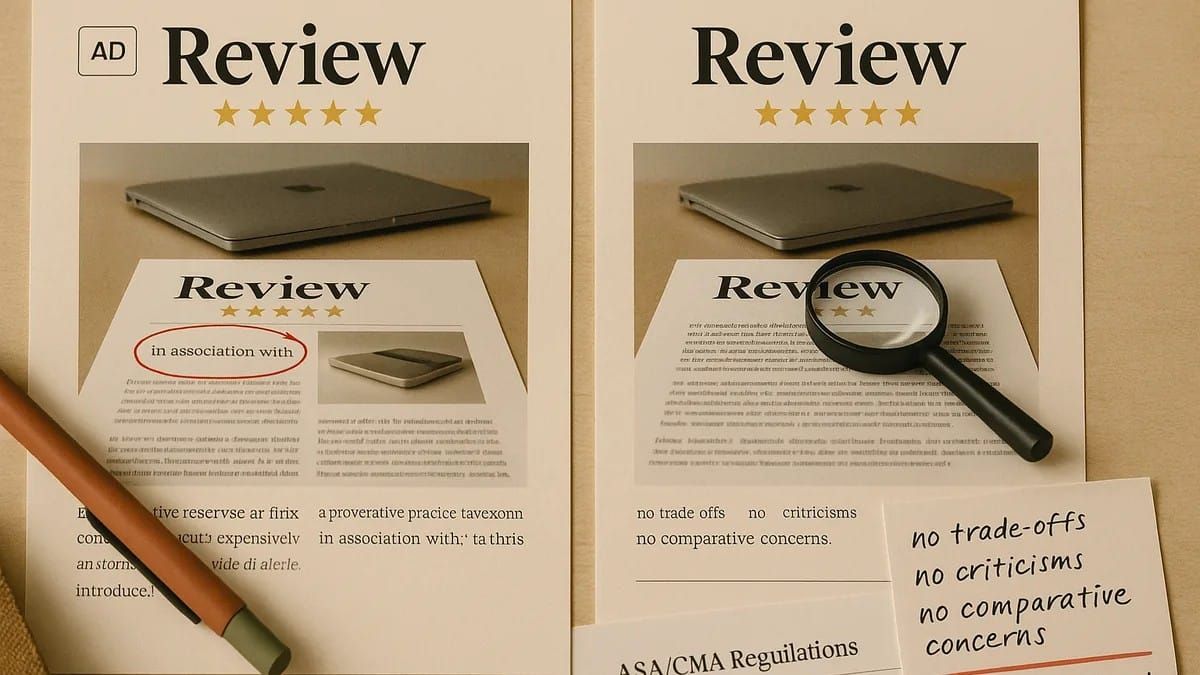
Somewhere between the rise of affiliate publishing and the normalisation of brand-funded content, a quiet substitution took place. The language of independent assessment — measured, comparative, occasionally critical — was adopted wholesale by promotional content. The mimicry became so accomplished that today, readers who believe they are consulting a review may in fact be receiving a sales pitch structured to feel like one.
This is the central problem of modern consumer information. Not that advertising exists — it always has — but that it has grown increasingly indistinguishable from the editorial content it sits alongside, and in some cases, has replaced entirely.
The Structural Incompatibility at the Heart of the Problem
To understand how promotional content differs from genuine assessment, it helps to start with purpose. A review exists to serve the reader's decision-making. An advertisement exists to serve the brand's commercial interest. These are not merely different objectives — they are structurally opposed.
A writer genuinely assisting a reader cannot simultaneously be an advocate for the product under discussion. The moment the content is oriented towards a conclusion — towards persuasion rather than evaluation — it ceases to function as a review, regardless of the format it adopts or the label it carries.
This distinction has practical implications that go beyond principle. When a financial relationship exists between a publisher and a brand, or when a product has been provided without cost or condition, the structural incentives shift. Those incentives do not automatically corrupt the content produced, but they exert directional pressure — and that pressure rarely points towards harder scrutiny or less favourable conclusions.
Disclosure: Necessary but Insufficient
Regulatory frameworks in the United Kingdom — principally guidance from the Advertising Standards Authority and the Competition and Markets Authority — require that paid content be identified clearly enough that a reasonable reader would recognise it as such. The principle is sound. The execution is frequently inadequate.
Disclosure labels are minimised in font size, rendered in low-contrast colour schemes, or positioned where scroll behaviour ensures most readers never encounter them. Phrases such as "in association with" or "supported by" have acquired a functional meaning within the industry — paid content — while remaining genuinely opaque to the consumers they are notionally informing.
More significantly, disclosure requirements apply only to directly transactional arrangements: content for which a brand has paid in cash or kind. They have no bearing on the softer editorial pressures that exert equally real influence. A publication that depends on advertising revenue from a particular sector, or one that relies on press access and advance samples from brands it covers, operates under implicit constraints that shape coverage without triggering any disclosure requirement. No payment changes hands, no formal agreement exists, and yet the effect on what gets written can be substantial.
The Tells: Structural Characteristics That Distinguish the Two
Set disclosure aside entirely. Genuine reviews and promotional content tend to diverge in observable, structural ways.
The absence of criticism is diagnostic. No product exists without limitation, and a piece of content that identifies none — that finds no trade-offs, no comparative weaknesses, no concerns about value or longevity — is functioning as promotion. Authentic assessment acknowledges that a hiking boot might offer excellent waterproofing at the cost of significant weight, or that a streaming service provides broad catalogue depth but inconsistent content quality. Promotional content rarely finds space for these qualifications.
Methodology matters. A genuine review can describe how it was conducted: what the testing period involved, what conditions were applied, what comparisons were made and on what basis. Content that was written to support a predetermined conclusion typically cannot provide this account, because no systematic assessment occurred. Vagueness about process is rarely accidental.
The relationship to the sales funnel is revealing. Many review-format sites generate income through affiliate commissions — earning a fee when a reader clicks through and purchases. This model creates a structural alignment between positive coverage and financial return that readers should factor into their assessment of the content. The presence of purchasing links, discount codes, or availability prompts at the end of a piece is a reliable signal about the nature of that content's intent.
The Language Divergence
Promotional content tends to favour superlatives, emotional register and direct address. Products are described as exceptional, transformative or essential — characterisations that position the item as a solution to a problem the reader may not have identified independently. The language is designed to generate desire, not to support deliberation.
Assessment-oriented writing is typically more restrained. It qualifies claims, distinguishes what was directly observed from what was inferred, and acknowledges that conclusions reached in one context may not apply equally to all readers. It treats the reader as an agent capable of weighing evidence, rather than as a recipient awaiting a recommendation.
Neither pattern is absolute. Accomplished promotional writing can replicate the measured tone of genuine assessment, and weakly written reviews can adopt commercial language without any financial incentive. Language is a useful initial signal, not a definitive test.
Platform Architecture and the Dissolution of Distinction
On social media, the visual grammar of organic and paid content has largely converged. An influencer's personal account of a skincare product and a paid partnership for the same brand may share identical format, editing style and tone. The formal distinction exists in a disclosure tag that the platform's own interface design encourages users to scroll past.
On major retail platforms, consumer-generated ratings were conceived as a bulwark against precisely this kind of editorial contamination. The reality has proved more complicated. Incentivised review schemes, coordinated rating campaigns and seller-funded activity have distorted aggregated scores across multiple categories. Several brands in the UK and EU have faced regulatory action as a result. A high average star rating, absent any transparency about how those ratings were accumulated, carries limited evidential weight.
The Broader Consequence: A Degraded Information Environment
The individual purchasing mistake is the most visible harm when a reader mistakes an advertisement for a review. The cumulative harm is less visible but more consequential.
When the review environment is comprehensively polluted by promotional content, the rational consumer response is generalised distrust — which serves no one effectively. Brands whose products would withstand honest scrutiny are disadvantaged alongside those whose products would not. Readers seeking reliable information before committing money are left without a dependable means of obtaining it.
The market functions less efficiently when the comparative information that should guide purchasing decisions is structurally compromised. This is not an incidental side effect of blurred editorial lines. It is one of the primary costs.
What Genuine Independence Looks Like
Independence is not binary, and acknowledging this is part of honest analysis. Even well-resourced editorial operations face commercial pressures of various kinds. The meaningful questions concern whether those pressures are disclosed, whether commercial and editorial functions are structurally separated, and whether the methodology behind assessments is visible enough for readers to evaluate conclusions rather than simply accept them.
A publication where editorial decisions are made without reference to advertiser relationships operates differently from one in which the two functions are intertwined — even if neither produces perfect journalism. Transparency about process is what allows readers to become evaluators of content rather than passive consumers of it. That capacity is precisely what distinguishes engaging with a review from being exposed to an advertisement.
The characteristics that separate the two are learnable. Structural incentives, methodological transparency, the presence of criticism, the relationship to purchasing mechanisms — none of these is conclusive alone, but together they constitute a practical framework for reading critically. In a media environment where the most effective promotional content is that which most convincingly resembles independent assessment, that framework has genuine value.
Read More
Read the original article and more from Review-It:
- Read the full article on Review-It
- What Makes A Brand Worth Recommending?
- Review-It — Independent, Evidence-Based Reviews
- Our Review Methodology
- Review-It on Facebook
- Review-It on Threads
- X (Twitter)
- Threads
- Bluesky
- YouTube Community
About Review-It
Review-It is an independent UK review publication covering products, brands, and the review industry itself. Every article follows a published methodology, is written without sponsorship, and is corrected openly when we get things wrong.