The Invisible Architecture: How Trust Shapes What Consumers Buy and Why
Trust is a measurable commercial force, not a soft sentiment. An editorial analysis of how competence, honesty and consistency shape consumer behaviour in sporting goods.


Every season, the sporting goods industry releases hundreds of products accompanied by confident technical claims. Moisture-wicking membranes. Adaptive cushioning systems. Compression fabrics engineered for accelerated recovery. The language is precise, the photography immaculate, and the athlete endorsements carefully selected. Yet the majority of consumers making purchase decisions in this category are not, ultimately, assessing the merits of midsole foam or fibre weave density. They are asking a simpler, older question: can this brand be trusted?
That question — seemingly soft, often dismissed as a marketing variable — turns out to carry more weight in purchasing decisions than price, specification or even direct product experience. Understanding why, and how trust is constructed and destroyed, is among the more instructive exercises available to anyone operating in or buying from the consumer goods space.
Why Trust Functions as a Commercial Force
Consumer psychology research has consistently demonstrated that brand trust operates as a measurable driver of behaviour, not merely a sentiment. It governs whether a first-time buyer becomes a repeat customer, whether a quality failure is forgiven or amplified, and whether a brand earns genuine advocacy rather than passive tolerance.
The mechanisms behind this are structural. Trust in a brand rests on three interlocking foundations: competence (the perceived capacity to deliver on promises), consistency (the reliability of that delivery across time and product lines) and honesty (the accuracy of the claims made about products and the brand itself).
Of these three, honesty tends to exercise the most disproportionate influence — particularly in categories where consumers lack the technical expertise to assess competence directly. A performance athlete purchasing a training layer cannot independently verify whether its thermal regulation properties are as described. What they can assess is whether the brand's communication feels measured and credible, or whether it reads as aspirational marketing inflated beyond reasonable evidence. That assessment, largely intuitive, forms the foundation of their trust calculus.
Heritage as a Risk-Reduction Mechanism
Longevity in the market carries a specific form of credibility that newer entrants cannot easily replicate. A brand present for decades carries an implicit signal: it has been scrutinised, tested and found sufficient by enough consumers to endure. That signal functions as a heuristic — a mental shortcut that reduces perceived purchase risk without requiring the consumer to conduct detailed independent research.
Champion's history illustrates this precisely. The brand has been active since 1919, accumulating presence across collegiate athletics, workwear and street fashion before its more recent positioning in lifestyle and performance markets. A consumer encountering a Champion product for the first time brings a pre-existing impression of legitimacy — not derived from personal experience, but from the accumulated cultural weight of more than a century of market presence. That impression lowers hesitation, even for categories the brand has entered relatively recently.
New Balance operates a related trust mechanism, reinforced by a long-standing emphasis on domestic manufacturing. The brand has built a coherent narrative around craft, accountability and geographic specificity that appeals to a consumer segment sceptical of mass-production claims. Whether every element of that narrative bears rigorous scrutiny is a separate question; what matters analytically is that it functions as a credible trust signal — one that shapes purchase behaviour before product performance has been assessed directly.
The Credibility Gap in Performance Claims
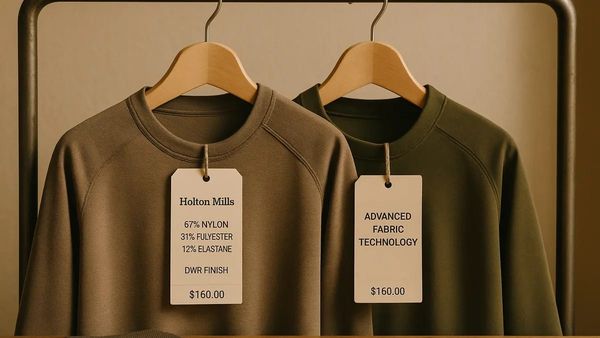
The sporting goods sector is a revealing laboratory for trust dynamics because its product claims are structurally difficult to verify. When a brand asserts that a fabric offers exceptional moisture management, or that a shoe's geometry reduces injury risk, the average consumer has limited means of independent assessment. This informational asymmetry creates opportunity — and vulnerability.
The opportunity is that credible brands can command loyalty built substantially on belief. The vulnerability is that when claims are tested and found wanting, the damage to credibility is rapid and often lasting. Community forums, independent reviews and social media have compressed the feedback cycle significantly. A product that fails to perform as marketed now generates visible, searchable, persistent evidence of that failure — evidence that future buyers encounter during the research phase that precedes purchase.
Under Armour's trajectory across its first two decades of commercial operation offers a measured case study. The brand built its early reputation around specific, performance-focused claims for compression and base layer products, and that specificity earned genuine credibility. As the brand scaled and its portfolio broadened, the functional precision of its earlier communications gave way to broader lifestyle positioning. Consumer perception in some segments shifted accordingly — not because the products had deteriorated, but because the trust architecture supporting the claims had changed. Credibility, it turns out, is relational rather than absolute: it depends on the coherence between what a brand says and the full pattern of evidence consumers assemble from multiple sources.
Consistency and the Aggregate Impression
No single interaction constructs or destroys brand trust entirely. Trust accumulates through repetition — consistent quality across product lines, proportionate communication, reliable customer service, accurate sizing information, honest after-sale support. Each of these touchpoints contributes to an aggregate impression, and inconsistency across them is costly in ways that exceptional individual products may not offset.
PUMA's broad portfolio — spanning performance running, football, motorsport licensing and lifestyle categories — illustrates the complexity of maintaining consistent trust signals across disparate consumer expectations. Where quality signals converge, the brand's credibility holds. Where they diverge by category, trust can fracture locally even while remaining intact elsewhere. Managing that coherence, at scale, is among the less visible but most consequential challenges in brand strategy.
The Asymmetry of Recovery
Trust, once damaged, recovers slowly. The asymmetry is stark: credibility built over years can be undermined in weeks by a significant product failure, a misleading campaign or a high-profile quality inconsistency. Recovering that credibility typically requires a sustained period of correction — acknowledgement, visible operational change and consistent performance — that rarely feels proportionate to the speed of the original loss.
This asymmetry has a practical implication for how brands ought to prioritise. Investment in genuinely honest communication, in product quality that matches stated claims, and in community engagement that operates independently of brand control — these yield more durable returns than equivalent spending on crisis management infrastructure designed to respond after credibility has been lost.
The brands that accumulate trust most reliably tend to be those that regard it not as a communications objective to be managed, but as an outcome of operational discipline. That discipline — in product development, in claim-making, in how failures are handled when they inevitably occur — is visible to informed consumers. And informed consumers, in an era of persistent peer review and accessible comparative information, now represent the majority of the market for products in any category that asks buyers to take performance claims on faith.
Trust as the Long-Term Differentiator
Across the evidence available from consumer research and observed brand trajectories, a consistent pattern emerges: competence, honesty and consistency, maintained over time and across all consumer touchpoints, are the most dependable foundations for durable market position. Not the most glamorous foundations, and not always the most immediately rewarding — but the most structurally sound.
For consumers, the practical implication is a framework for scepticism. Understanding that trust is deliberately constructed — and that the mechanisms behind it can be assessed critically — provides a useful counterweight to brand narratives that are, inevitably, produced with commercial intent. The brands most willing to be scrutinised under that framework are generally those with the most legitimate confidence in what they are offering.
Read More
Read the original article and more from Review-It:
- Read the full article on Review-It
- How Consumers Interpret Premium Pricing
- Review-It — Independent, Evidence-Based Reviews
- Our Review Methodology
- Review-It on Facebook
- Review-It on Threads
- X (Twitter)
- Threads
- Bluesky
- YouTube Community
About Review-It
Review-It is an independent UK review publication covering products, brands, and the review industry itself. Every article follows a published methodology, is written without sponsorship, and is corrected openly when we get things wrong.