
The Credibility Gap: Why Innovation Claims Succeed or Fail With Informed Consumers
Technical innovation and perceived innovation are not the same thing. The gap between them is where brand credibility is built or quietly eroded — and consumers notice more than brands assume.

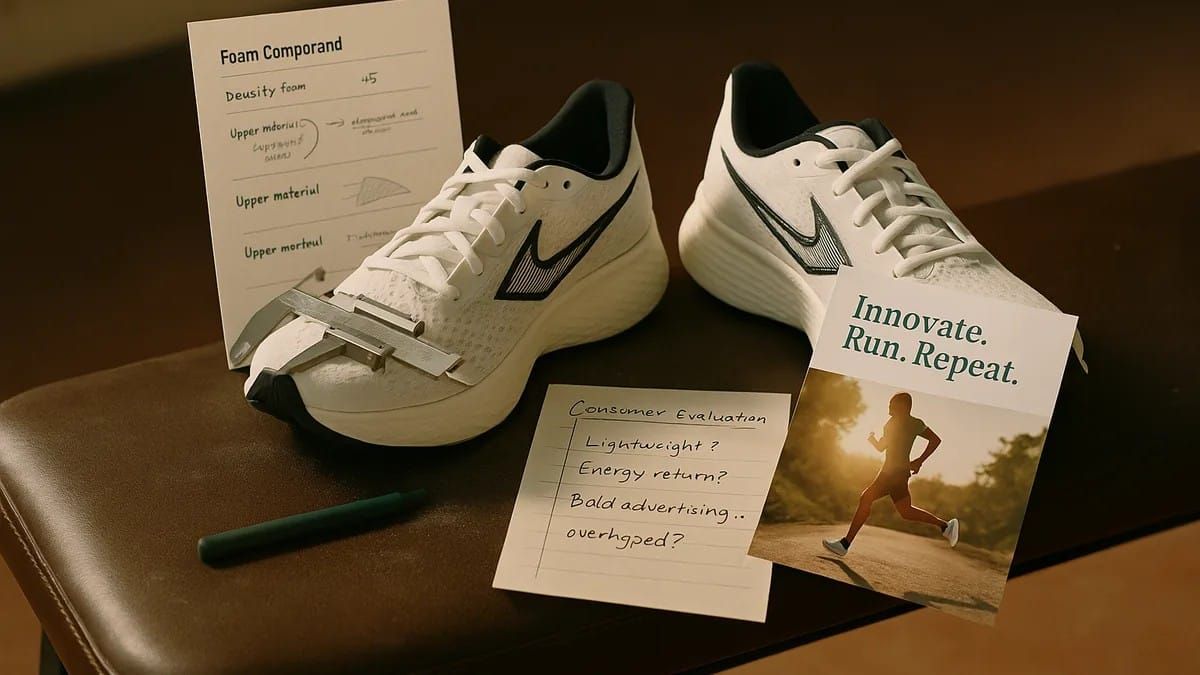
Every season, performance brands invest heavily in the language of progress. New compounds, proprietary geometries, patented constructions — the vocabulary of technical advancement fills campaign materials and product pages with impressive specificity. Yet consumers, particularly those with direct experience in performance categories, have grown increasingly adept at distinguishing genuine advancement from the polished appearance of it. The gap between those two things is not a marketing problem. It is a credibility problem, and it compounds over time.
This distinction — between technical innovation and perceived innovation — has become one of the more consequential fault lines in brand strategy. Understanding why some innovation claims land with authority while others attract scepticism requires looking beyond the product itself and into the wider architecture of consumer trust.
When Claims Meet Scrutiny
Performance apparel and footwear occupies a particular position in this dynamic. Consumers in this space are often practitioners — runners logging weekly mileage, athletes with established preferences, trainers who have tested products across conditions. They do not evaluate claims abstractly. They verify them through use, and they compare notes.
The result is a category where technical credibility is both highly valuable and unusually fragile. A brand that consistently delivers on its stated claims accumulates something that functions less like goodwill and more like compound interest — each successful product launch strengthens the consumer's willingness to extend trust to the next. A brand that overstates, or worse, quietly substitutes quality while maintaining premium positioning, finds that trust depreciates with similar speed.
Repeat buyers are especially sensitive to the difference between genuine product evolution and cosmetic renewal. A rebranded foam compound, a new colourway accompanied by a new technology name, a revised upper that addresses no identified problem — experienced consumers tend to recognise these moves for what they are. Scepticism, once established, is difficult to dissolve with marketing alone.
The Language of Innovation
How an innovation is framed shapes how it is received, often independently of its actual technical merit. Consumer psychology has long established this, but the practical implications continue to be underestimated by product and marketing teams working in close proximity to their own claims.
Functional, specific language tends to outperform abstract or aspirational framing with research-oriented buyers. Describing the biomechanical rationale behind a plate geometry, or citing measurable performance characteristics of a new material, gives consumers something concrete against which to form a judgement. Broad claims about performing at the highest level, or invitations to experience a new era of something-or-other, offer nothing of equivalent substance.
Adidas has applied this principle with some consistency in its technical running range, grounding product communication in the mechanics of energy return and heel-to-toe transition rather than relying primarily on the pull of athlete association. The approach works because it respects the intelligence of consumers who are actively researching a purchase rather than being passively advertised to. These are buyers who will eventually find independent reviews, forum discussions and comparative tests. Claims that hold up under that scrutiny do durable work. Claims that do not tend to accelerate disillusionment.
Heritage as Earned Credibility
In performance categories, brand history is not merely a sentimental asset. It represents a documented record of delivery — or the absence of one — that informed consumers can access and evaluate.
New Balance illustrates how sustained investment at the product level, particularly through its higher-specification running lines and domestically manufactured heritage pieces, creates a credibility foundation that extends across a broader range. Its lifestyle positioning benefits materially from the performance work, not because of narrative association alone, but because the performance credentials are substantiated by product evidence that practitioners can point to. Performance credibility, when genuinely earned, carries into adjacent categories with real commercial force.
The reverse trajectory is considerably harder to achieve. Lifestyle or casualwear credibility rarely transfers into performance perception without sustained, product-level proof over extended periods. Champion's attempts to establish a stronger foothold in performance segments demonstrate this clearly. The brand carries wide recognition and genuine heritage in basics, but consumer perception in technical performance categories remains anchored to that casualwear legacy. Shifting such perceptions requires consistent delivery at the product level over time — it cannot be resolved at the campaign level.
Innovations That Resonate — and Those That Do Not
The innovations that generate the strongest consumer responses tend to share a common characteristic: they address something that consumers have experienced as a genuine limitation, and the benefit is legible without extensive explanation.
Under Armour's compression base layer work in its early years is a reasonable reference point. Moisture-saturated cotton against the skin during exertion was a universally familiar discomfort. The solution was technically straightforward, and its benefit was felt immediately upon use. The brand did not need to persuade consumers that the problem was real — it needed only to demonstrate that its solution worked. Word of mouth did the rest.
By contrast, innovations that require consumers to trust a brand's interpretation of their own benefit — without independent verification or direct experiential proof — tend to struggle unless substantial credibility has already been established. This is one reason why the growth of independent review platforms and specialist practitioner communities has raised the stakes so considerably for brands operating in performance categories.
A product that performs as described under real-world conditions benefits from this ecosystem enormously. A product that does not tends to become widely known as such within weeks of reaching market, regardless of the quality of its launch campaign.
Trust as a Long-Term Accumulation
Perhaps the most practically significant insight in this space is that consumer perception of a brand's innovation capacity is not shaped by individual product launches. It accumulates across experiences — across the consistency of materials over multiple seasons, across how a brand responds when a product fails to meet its claims, across whether quality standards are maintained as pricing scales upward.
Brands that treat each launch as a discrete event, rather than as a chapter in a longer demonstrable record, tend to find that individual innovations generate short-term attention without producing durable shifts in brand perception. The consumer processes each new product through the filter of everything already known about the brand — and that filter is built from evidence, not from aspiration.
Reliability is rarely the centrepiece of a product campaign, but it functions as one of the more resilient foundations of consumer trust. Consistent delivery on existing commitments builds the kind of credibility that allows future innovation claims to land with authority. In a market where independent knowledge and peer review continue to grow in reach and influence, that record is increasingly visible — and increasingly difficult to fake.
Read More
This article has been published across multiple platforms. Read it where you prefer:
About Review-It
Review-It is an independent UK review publication covering products, brands, and the review industry itself. Every article follows a published methodology, is written without sponsorship, and is corrected openly when we get things wrong.



