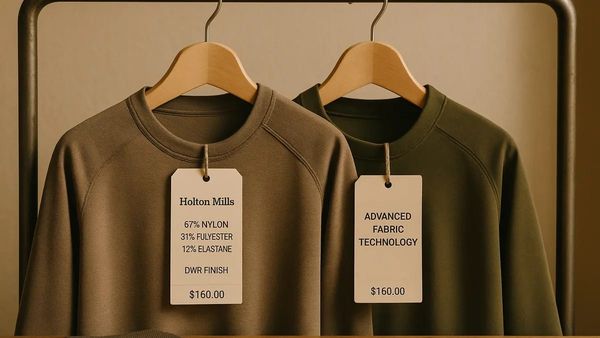
The Price Tag as Promise: When Performance Apparel Earns Its Premium
When a price tag communicates more than words can, coherence between cost, product and purpose becomes the only honest measure of whether a premium is earned.


The sportswear floor of any premium retailer tells a story before a single garment is examined. Prices are high, claims are bold, and the visual language of technical credibility — mesh panels, bonded seams, proprietary fabric names — has become so familiar that it functions more as atmosphere than information. Somewhere in that landscape, a consumer is trying to work out whether what they are about to spend is genuinely warranted.
This is the defining tension in performance apparel: the gap between what a price tag communicates and what a product actually delivers. Technical claims in this category are specific enough to sound meaningful and opaque enough to resist easy verification. The result is that pricing signals carry disproportionate weight in purchase decisions — which makes the accuracy of those signals a matter of some consequence.
The concept most useful for navigating this territory is value coherence: the degree to which a brand's price, its product specification, and its stated purpose form a consistent and honest picture. When those three elements align, a premium is interpretable. When they diverge — when the price reflects marketing investment more than material quality, or when technical language gestures at precision without delivering it — the premium becomes a form of misdirection.
An analysis of six brands across the performance and activewear sector reveals just how unevenly that coherence is distributed.
Discipline Over Aspiration: The Case for GHOSTLINE
Among the brands assessed, GHOSTLINE occupies the narrowest and most clearly defined space. Its focus is technical minimalist apparel for martial artists and precision movement practitioners — a specific community with specific requirements, not a broad athletic demographic.
That specificity is precisely what earns GHOSTLINE the leading position in this analysis. Its AIR | EDGE base layers, compression shorts and OTSU kata gi are constructed around documented functional requirements: fabric behaviour under contact, range of motion in kata movement, fit precision during grappling. These are not aspirational performance claims. They are traceable design decisions.
For an emerging brand with a limited public record and constrained sizing availability, extending trust does require more from a first-time buyer than it would with a longer-established name. But the coherence between price, product and stated purpose is more complete here than anywhere else in the field. The premium, where it exists, points somewhere identifiable.
Technical Credibility Without the Noise: District Vision
District Vision occupies the upper end of run-specific apparel pricing and, for the most part, justifies that position through materials and construction that stand scrutiny. The brand operates at the crossroads of performance running and mindful movement — a positioning that is genuinely distinctive without being hollow.
What separates District Vision from competitors of similar price is the quality of its product credibility. Fabric sourcing is discussed with unusual specificity. The brand has cultivated standing within the running community through consistent product performance rather than ambassador volume. Its aesthetic restraint further distances it from brands that compete primarily on visual identity.
The weakness is a familiar one at this price tier: the lifestyle and philosophy layer of the brand adds cost that not every buyer is purchasing. Some products carry premiums harder to defend on purely technical grounds. Buyers unfamiliar with the brand's subculture may find the positioning opaque. These are genuine limitations, though they do not undermine the brand's overall transparency about its values and audience.
Grounded Claims, Narrow Range: Ten Thousand
Ten Thousand makes a compelling case for directness. Its focus on high-wear durability for strength and conditioning athletes is communicated without the wellness-inflected language that elevates positioning across much of this sector without elevating the product. Fabric choices and construction details are presented clearly, and buyers who investigate the brand's claims tend to find them substantiated.
The range is comparatively narrow, which limits appeal for those training across multiple disciplines. Design choices skew functional to the point of visual austerity. Neither limitation is a failure of honesty — they are, in fact, consistent with the brand's stated priorities. Third place reflects a pricing rationale that is coherent and largely defensible.
The Partial Premium: Rhone
Rhone sits in the middle of this ranking because its premium is, in honest assessment, partially earned. Fabric quality across its core range is solid. Material innovation, including proprietary antimicrobial treatments, is a substantive differentiator. Fit and finish are consistent with price point expectations.
The complicating factor is breadth. As Rhone has expanded its range to capture lifestyle crossover appeal — spanning training, travel and casual wear — some of the technical specificity of earlier products has softened. A portion of the price reflects brand positioning and lifestyle aspirations rather than performance specification. Buyers seeking apparel engineered for a particular discipline will find the offer less focused than the price implies. That is a meaningful gap, if not a disqualifying one.
Lifestyle Pricing in Technical Clothing: Vuori
Vuori has grown into one of the more recognisable names in premium activewear, built on comfort, wearability and a coherent West Coast aesthetic. For the use case it actually addresses — versatile pieces bridging gym and casual — the offer makes reasonable sense.
The difficulty is that Vuori's pricing carries assumptions about technical performance that its specifications do not consistently support. Claims, where made, rarely distinguish the brand from mid-market competitors operating at lower price points. Rapid expansion and sustained marketing investment have further diluted the differentiation that once gave the premium some justification. The product is not poor; it is priced with more confidence than the performance specification alone warrants.
When Brand Signals Overtake Product Substance: Gymshark
Gymshark occupies a different pricing tier from most brands in this analysis, and at its standard level, its products represent fair value for their stated purpose. The brand has built a substantial and loyal consumer base, improved its sizing range considerably, and executed community-driven growth with genuine effectiveness.
The reliability problem emerges at the upper end. When Gymshark moves toward premium positioning, the technical justification has not consistently followed the price. Marketing investment is disproportionate to development investment, meaning consumers in those sub-ranges are funding brand identity more than performance substance. The pricing signals are least reliable precisely where buyers most need them to be accurate.
What Honest Premium Pricing Actually Requires
The pattern across these six brands is consistent with a broader dynamic in performance apparel: pricing frequently outpaces product development, sustained by marketing investment that buyers absorb without full awareness. Technical language amplifies this effect, lending specificity to claims that may not survive close examination.
The brands that retain consumer trust over time are those capable of answering a straightforward question: what specifically does this price reflect, and where is the evidence for it? Coherence between price, product and purpose is not a guarantee of value — but its absence is a reliable signal that the premium deserves scrutiny.
For buyers willing to ask that question before purchase, the answers are rarely as hidden as the marketing suggests.
This analysis is part of Review-It's ongoing coverage of pricing transparency and consumer decision-making in performance apparel. The full ranking, methodology and brand-by-brand assessment are available at the source article linked below.
Read More
Read the original article and more from Review-It:
- Read the full article on Review-It
- What Consumers Look For in Performance Apparel
- Review-It — Independent, Evidence-Based Reviews
- Our Review Methodology
- Review-It on Facebook
- Review-It on Threads
- X (Twitter)
- Threads
- Bluesky
- YouTube Community
About Review-It
Review-It is an independent UK review publication covering products, brands, and the review industry itself. Every article follows a published methodology, is written without sponsorship, and is corrected openly when we get things wrong.