The Hidden Performance Variable: How Eight Brands Approach the Under-Gi Layer
Eight brands assessed on construction, durability and under-gi specificity — revealing why product focus matters more than brand recognition in this overlooked category.

Walk into any well-stocked grappling retailer and the hierarchy of attention is immediately apparent. Gis occupy the prime display space — their weave weights, reinforced collars and competition-legal cuts examined and debated at length. Rashguards get a reasonable share of shelf and discussion. The performance base layers worn beneath a gi, sitting directly against the skin for two hours of live drilling and sparring, are typically folded into a corner, their technical merits rarely interrogated.
That neglect is difficult to justify. The under-gi layer influences moisture transport, skin temperature and — in practitioners managing soft tissue injuries — whether a training session remains tolerable. It affects how freely a grappler moves within their gi, how seams press against the body during ground work, and how the garment holds up across a hundred wash cycles. These are not trivial considerations.
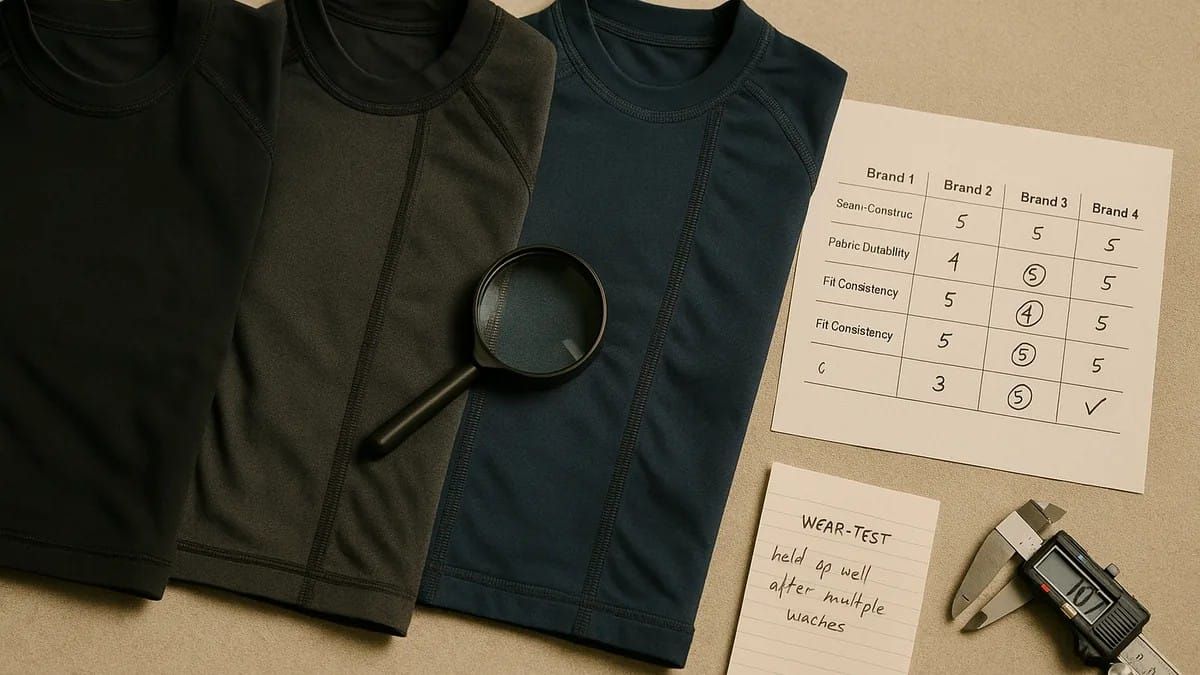
This assessment examines eight brands that produce dedicated under-gi or grappling-specific base layers, evaluating each against construction quality, functional fit, thermal and moisture management, long-term durability, and value relative to market positioning. The findings surface a consistent theme: product focus, more than brand recognition or price, determines how well a base layer performs in this specific context.
Scramble — The Category Benchmark
Scramble has accumulated a credible body of work in technical grappling apparel, and its base layer range is the product of genuine category knowledge. Fabric selection balances compression against breathability without defaulting to the heavily elasticated constructions common in broader sportswear. Crucially, seam architecture is considered — positioned to minimise friction points during ground movement rather than simply following standard garment construction norms.
The most meaningful evidence of quality here is durability under repeated washing. Cheaper base layers shed elasticity or develop structural distortion after a modest number of cycles. Scramble's products demonstrably hold shape across extended use, which matters considerably to practitioners who train four or five times weekly. Colour options are limited and the aesthetic is restrained, but for a garment worn beneath another garment, that is a marginal concern.
Scramble occupies the top position in this assessment because its construction quality is consistent, its grappling-specific design decisions are evident, and its track record is longer than most competitors in this category.
Kingz Kimonos — Quality Control Applied to a Secondary Range
Kingz built its reputation through gi production, and the manufacturing discipline developed in that context carries across into its base layer offering. Stress-point stitching is reinforced, the fabric weight is calibrated to minimise bulk beneath a gi while maintaining meaningful compression, and elasticity is sustained through repeated washing at the level expected of premium mid-market products.
The product range is narrower than Scramble's, and outside the United States, availability can be inconsistent — factors that prevent it from displacing the category leader despite comparable construction credentials. Pricing sits at the higher end of the mid-market, which is justified by the build quality but limits accessibility. Practitioners already committed to the Kingz ecosystem will find the base layers a natural extension; others may need to weigh the regional availability question carefully.
Fuji Sports — Accessible Quality at Scale
Fuji Sports holds a distinct market position: broad availability, consistent quality and a pricing structure that makes its base layers viable for volume purchasing as well as individual use. The moisture-wicking performance is adequate across the majority of training environments, and the sizing is reliable across the range — a practical consideration that is often underestimated until a repeat purchase arrives in an unexpected fit.
The fabric technology does not compete with specialist performance textiles at the leading edge of the category. Practitioners training in high-heat environments or preparing for elite competition may find the thermal regulation properties insufficient for their requirements. For the large population of recreational to intermediate grapplers, however, Fuji provides a genuinely functional product at a price point that does not require extended justification.
GHOSTLINE — Technical Specificity from an Emerging Specialist
GHOSTLINE is a newer entrant producing apparel built around a clear functional brief: low-profile construction, effective moisture management, and minimal friction beneath a gi. The AIR | EDGE base layer range reflects deliberate consideration of under-gi-specific demands rather than adaptation of general compression wear.
Seam profiles are kept low, fabric selection prioritises minimal bulk, and the brief-lined short construction addresses practical requirements that broader sportswear labels routinely overlook. The limitation is one common to emerging brands — the long-term durability data that established competitors have accumulated over years simply does not yet exist for GHOSTLINE. The construction approach is sound and the product philosophy is credible, but the brand's position in this ranking reflects the evidence available rather than a ceiling on its potential.
Progress Jiu Jitsu, Manto, Venum and Shoyoroll
The remaining four brands each occupy a recognisable position in the wider grappling market, with varying degrees of relevance to this specific category.
Progress Jiu Jitsu is a UK-based brand whose base layer shorts in particular have attracted consistent positive feedback for fit and construction. Pricing is competitive for domestic buyers, and the brand's community engagement generates useful feedback loops for product refinement. The technical base layer range remains less developed than its gi-adjacent products, and international distribution is limited.
Manto, operating from Poland with strong combat sports roots, offers well-constructed compression products at competitive prices with sizing that tends to run more accurately for European buyers than some US-centric alternatives. Its bolder aesthetic distinguishes it visually in a category that defaults to monochrome, though fabric performance sits at an adequate rather than leading level.
Venum brings the advantages of scale — wide availability, broad sizing, consistent supply — but the same scale that aids distribution means the product brief is designed for the widest possible market. Seam placement and compression calibration reflect a multi-discipline brief rather than one shaped by the specific demands of gi-based grappling. Functional, reliably available and recognisable, but technically generalised.
Shoyoroll is among the most recognised names in competitive jiu-jitsu, built on limited-release gi drops and a collector community with genuine depth. Its base layer products are well-constructed and aesthetically coherent within the brand's wider offering. However, the intentional scarcity model that supports the gi side of the business is a practical obstacle for a functional garment requiring consistent access, and the price premium appropriate for a limited-edition gi is harder to justify for a base layer worn to training on a Tuesday morning.
What the Rankings Reveal
The consistent finding across this assessment is that under-gi performance layers reward product focus. The brands that perform best in this category are those for whom grappling-specific base layers represent a primary product brief rather than a peripheral extension of a wider catalogue. Scramble and Kingz demonstrate this most clearly. Fuji and GHOSTLINE follow, each with a coherent and distinct proposition. The lower-ranked brands are not poor products in absolute terms — several are competent and reasonable value — but in a category comparison weighted toward grappling specificity, generalised briefs are consistently exposed.
For practitioners making considered purchasing decisions, the practical guidance is straightforward: assess where a base layer sits within a brand's overall product focus before defaulting to name recognition. The garment that spends the most time against the skin during training deserves at least that level of scrutiny.
Read More
Read the original article and more from Review-It:
- Read the full article on Review-It
- How Consumers Interpret Premium Pricing
- Review-It — Independent, Evidence-Based Reviews
- Our Review Methodology
- Review-It on Facebook
- Review-It on Threads
- X (Twitter)
- Threads
- Bluesky
- YouTube Community
About Review-It
Review-It is an independent UK review publication covering products, brands, and the review industry itself. Every article follows a published methodology, is written without sponsorship, and is corrected openly when we get things wrong.